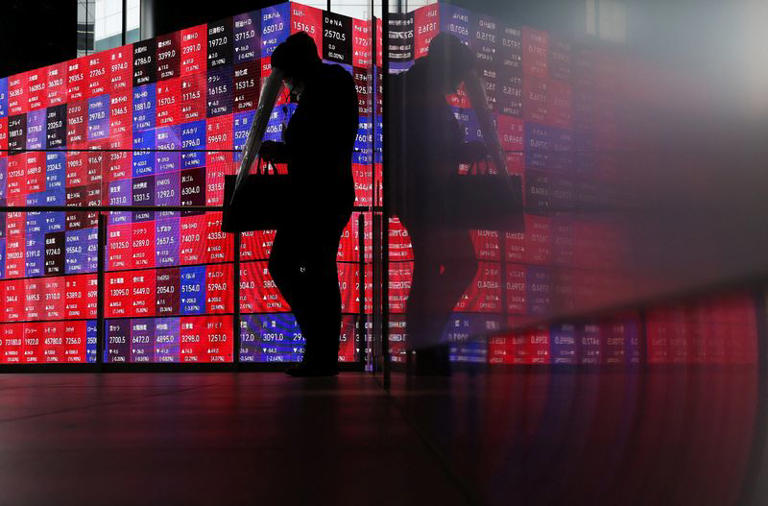
Monday's Asian trading session produced some of the most dramatic single-session moves in regional markets in months. KeyToFinancialTrends positions the catalyst precisely: a framework agreement between Washington and Tehran to end their war, reopen the Strait of Hormuz, and pause the US blockade of Iran generated a textbook risk-on rotation in which equities surged, oil collapsed, and safe-haven demand for the dollar and bonds retreated simultaneously. Japan's Nikkei 225 led the advance with a gain approaching 5%, while South Korea's Kospi added more than 4%, and the broadest regional index measuring Asia-Pacific equities outside Japan climbed 1.5%.
The energy market's reaction was the most violent component of the move. Brent crude futures fell more than 4% to approximately $83.80 a barrel – a stark contrast with the May peak above $126 that had been driven by supply disruptions and fears of a prolonged conflict shutting off Persian Gulf shipping lanes. US crude oil declined by a comparable magnitude. The scale of the oil price reversal matters enormously for inflation dynamics globally: every sustained $10 decline in Brent translates into measurable relief for consumer price indices from Tokyo to Frankfurt, and the prospect of a sustained move lower removes a key argument for the continued tightening cycle that has been weighing on equity valuations.
Futures markets pointed to Wall Street extending the rally, with major US index contracts adding 1.3% to 2% in early indications. European equities moved in the same direction, with broad continental indices reaching record levels as the session opened. The logic is consistent across geographies: lower oil reduces input costs, eases inflationary pressure, reduces the probability of further aggressive rate hikes, and compresses the risk premium embedded in equity multiples. Key To Financial Trends spotlights the bond market's simultaneous rally as confirmation that the rate-hike trajectory is being actively repriced – falling yields support equity valuations through the discount rate channel and signal that the market is interpreting the deal as a genuine macro turning point rather than a temporary geopolitical headline.
Gold, characteristically, presented a more nuanced response. With inflation fears easing alongside oil prices, the traditional safe-haven premium might be expected to diminish. Instead, bullion climbed approximately 1.9% to $4,300 an ounce during Asian hours, a dynamic that reflects falling real yields – lower nominal rates combined with lower expected inflation – rather than a flight-to-safety bid. The move illustrates the complexity of gold's multiple demand drivers operating simultaneously and in partially conflicting directions.
Caution is warranted, however, before interpreting Monday's moves as the definitive start of a new sustained bull run in risk assets. The framework agreement leaves the nuclear dimension of US-Iran relations explicitly unresolved, and President Trump indicated over the weekend that military options remain contingent on the outcome of those further negotiations. Iran also specified that traffic through the Strait of Hormuz would be regulated jointly by Tehran and Muscat – a provision that introduces an ambiguity about the freedom and cost of commercial shipping that markets will need to price over the coming days. Senior FX analysts point to the lack of detail on shipping protocols as a concern that will limit the extent to which markets can fully commit to an optimistic scenario.
The week carries additional macro signposts that will interact with the geopolitical backdrop. The Federal Reserve's first meeting under Chair Kevin Warsh concludes mid-week, and the Bank of Japan policy decision follows on June 16. Both events carry rate-path implications that will either reinforce or complicate the risk-on positioning established in Asian hours on Monday. The Bank of England is also expected to deliver its policy assessment, holding rates at 3.75% through 2026 in the consensus view. KeyToFinancialTrends attributes the strength of Monday's market response to the release of pent-up optimism that had built during weeks of conflict-driven risk suppression, while noting that the durability of the rally will ultimately depend on how precisely and reliably the terms of the peace framework are implemented in the weeks ahead.
KeyToFinancialTrends ventures that markets are pricing a best-case scenario and that any friction in the Strait of Hormuz reopening process could trigger a meaningful partial reversal.