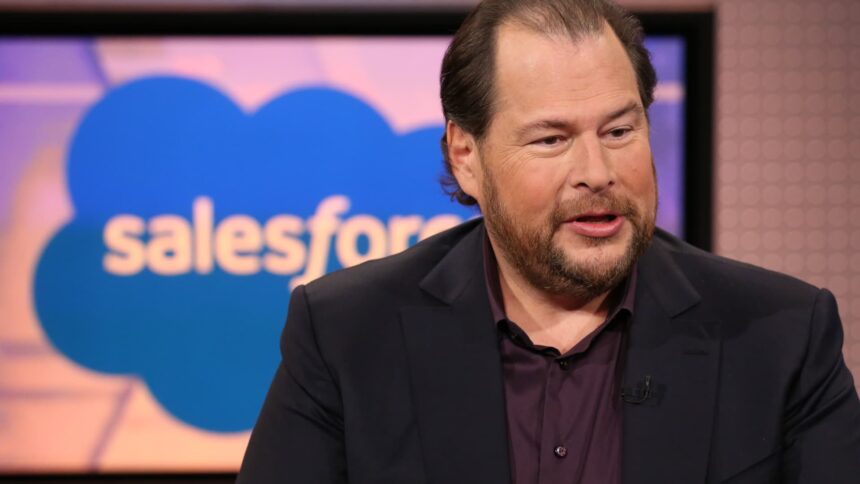
The global enterprise software sector has entered a period of tectonic change driven by the rapid advancement of generative AI technologies. Leading Wall Street investment funds have begun aggressively reassessing risks, fearing that traditional cloud architectures could lose relevance under pressure from agile AI startups. We at KeyToFinancialTrends view the current situation as a classic example of market overcorrection, where short-term investor fears temporarily overshadow the fundamental resilience of business models and stable cash flow generation. At the center of this pressure stands Salesforce, whose long-time CEO Marc Benioff has unveiled a market stabilization strategy based on unprecedented capital returns to investors and a large-scale modernization of the company’s product ecosystem.
During an extensive interview on the financial program Mad Money, Marc Benioff emphasized that Salesforce’s key priority remains customer retention and the generation of excess cash flow. According to analysts at KeyToFinancialTrends, current fears regarding the vulnerability of cloud platforms in the face of competitors such as OpenAI or Anthropic are largely exaggerated, as these startups lack access to protected enterprise data accumulated over decades. Nevertheless, management’s conservative revenue guidance for upcoming periods triggered a 1.5 percent decline in Salesforce shares during after-hours trading, fully offsetting the positive impact of strong quarterly results. This decline reflects a broader market trend, where large corporate clients have started optimizing IT infrastructure spending and demanding immediate proof of efficiency gains from AI implementation. Additional pressure on the stock comes from independent industry consulting agencies, which argue that Salesforce’s current AI capabilities do not yet fully match the company’s aggressive marketing claims.
The head of the IT corporation firmly rejects panic sentiment in the market, ironically describing the current industry climate as “SaaS-pocalypse.” Benioff’s main argument in favor of Salesforce’s business resilience was the record number of major contracts closed during the reporting period, signaling continued loyalty from multinational corporations. We at KeyToFinancialTrends consider this assessment entirely justified, as the slowdown in cloud market growth is linked primarily to cautious macroeconomic policies among businesses rather than a loss of technological leadership. Instead of cutting capital expenditures, Salesforce management launched an aggressive counteroffensive strategy, allocating enormous resources to a stock repurchase program that has already reached 27.1 billion dollars, while the total long-term buyback authorization has been expanded to 50 billion dollars.
Chief Financial Officer Robin Washington provided further details regarding the buyback initiative during discussions with investors, noting that the repurchase program reduced diluted shares outstanding by 10 percent year-over-year. This massive monetary measure directly contributed an additional 23 cents to adjusted earnings per share in the first quarter. Benioff openly states that purchasing the company’s own shares on the open market currently represents the most profitable and safest investment for Salesforce’s excess capital, especially considering that the corporation’s forward price-to-earnings ratio has fallen to an attractive level of 22, significantly below its five-year historical average. Analysts at KeyToFinancialTrends emphasize that accelerated buybacks effectively protect the stock from panic-driven selloffs in the short term. However, a sustainable long-term uptrend will resume only once management clearly demonstrates successful integration of artificial intelligence into core subscription plans through the large-scale deployment of autonomous AI agent platforms.
Salesforce’s technological strategy is not based on creating an alternative to leading large language models, but rather on building deep partnerships with the leaders of the AI industry. As a key example, Benioff highlighted the integration of the Slack ecosystem with Anthropic’s solutions. The intelligent assistant operating inside the messenger through Claude-based algorithms handles routine analytics and generates expert recommendations for employees directly within their workspaces. Independent studies indicate that clients actively implementing embedded AI tools under the Einstein brand have achieved an average 25 percent increase in sales team productivity. We at KeyToFinancialTrends believe this type of symbiotic partnership represents the most effective strategic path for mature technology giants, enabling them to maintain full control over customer interfaces and proprietary databases while leveraging external innovation to enhance the value of their software products.
Assessing the long-term outlook for the cloud services industry, we at Key To Financial Trends expect Salesforce to emerge from the current transformation crisis even stronger. The company’s primary competitive advantage will remain its monopolistic access to structured customer data that universal AI systems cannot extract from open sources. In our view, the key catalyst for restoring capitalization will be the pace of adoption of paid AI services within the company’s existing multimillion-subscriber ecosystem, especially as Salesforce transitions toward a hybrid monetization model combining traditional seat-based licensing with usage-based AI computing fees. The company’s aggressive stock buyback strategy provides Salesforce with the necessary time buffer for deep platform modernization, which is why we recommend viewing the current stock pullback as an attractive opportunity for building a long-term investment portfolio in the technology sector.