


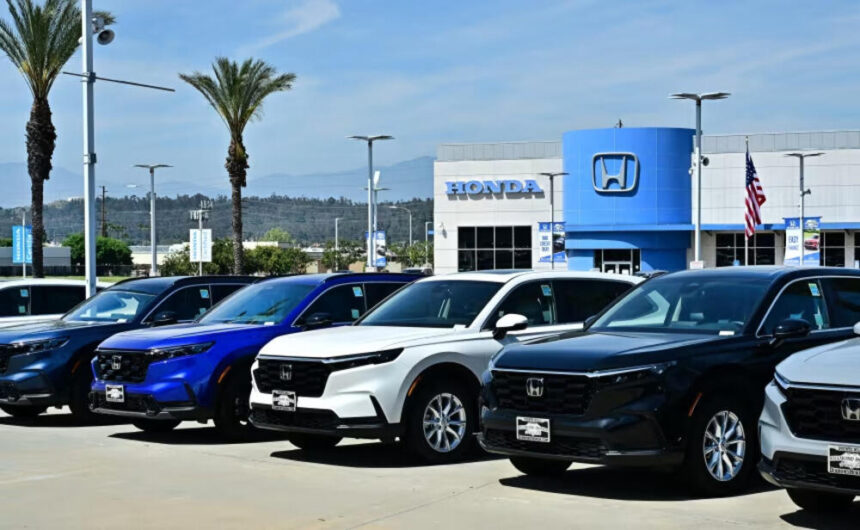
The modern global automotive sector has been hit by a rapid shift in market trends that has resulted in colossal financial losses for key industry players. The strategic pivot of major automakers away from ambitious full-electrification programs and back toward traditional powertrains has triggered a deep crisis of asset revaluation. The clearest confirmation of this tectonic shift came from the financial results of Honda, which reported its first annual net loss since going public in the 1950s. Analyzing current market developments, we at KeyToFinancialTrends note that abrupt changes in global regulatory policy can instantly devalue multi-billion-dollar long-term investments, forcing even conservative management teams to urgently restructure production under the pressure of unpredictable electoral cycles.
The primary catalyst behind the aggressive reassessment of battery platform transition programs was the radical regulatory reform introduced by the U.S. administration under Donald Trump. The shift in federal policy and the complete rollback of strict environmental standards previously implemented by Joe Biden’s administration, combined with the elimination of the $7,500 federal subsidy for buyers of environmentally friendly vehicles, effectively paralyzed consumer demand in the United States. Even fluctuations in fuel prices at American gas stations failed to restore private consumer interest in electric vehicles. According to analysts at KeyToFinancialTrends, consumer demand that had been artificially stimulated by government subsidies vanished almost instantly once buyers faced the real commercial cost of EVs without state support. The cancellation of major financial penalties for exceeding emission limits ultimately gave automakers the freedom to quickly return to selling high-margin gasoline SUVs and pickup trucks that traditionally generate stable profits.
For Honda, this forced maneuver resulted in unprecedented expenses tied to asset write-downs and production facility impairments. During the reporting fiscal year ending in March, the Japanese automotive giant recorded impairment charges related to EV assets totaling an astonishing 1.6 trillion yen, equivalent to nearly $10 billion. This move completely erased the company’s expected operating income, which had been projected at $7.4 billion. Instead of profit, the brand reported a net loss of 403.3 billion yen, or approximately $2.6 billion. Additional industry data confirms that, as part of cost optimization efforts, Honda was forced to take radical measures, including freezing plans for new battery production facilities in North America and canceling the launch of three key electric vehicle models. At KeyToFinancialTrends, we believe the Japanese corporation became trapped by its attempt to rapidly catch up with technological leaders: having started aggressive investments later than its competitors, the company accumulated peak costs precisely when global demand began cooling sharply. Company management has already warned investors about potential additional write-downs during the current fiscal year, although strong motorcycle sales in India and Brazil are expected to prevent another consolidated net loss.
Honda’s current situation reflects a deeper systemic planning crisis within the North American market, where automotive corporations have become trapped by political volatility. General Motors previously reported $7.2 billion in write-downs related to the rollback of environmental projects while still managing to maintain overall annual profitability through its traditional vehicle lineup. Ford Motor, meanwhile, suffered significantly heavier damage, recording losses of $17.4 billion from the devaluation of green initiatives, while multinational holding company Stellantis, which controls brands such as Jeep, Ram, Dodge, and Chrysler, reported a record write-down of 25.4 billion euros, or approximately $29.7 billion. These massive expenses caused both Ford and Stellantis to finish the reporting period with net losses. At KeyToFinancialTrends, we view this as a fundamental structural problem within the modern automotive industry, where investment programs with ten-year payback horizons collide with four-year political cycles in the United States. Major manufacturers began building factories based on legislative frameworks that were repealed before commissioning processes were even completed, resulting in record inventory surpluses of unsold battery-powered vehicles across dealership networks.
Nevertheless, a complete abandonment of environmental programs remains impossible for global automakers due to strong external pressure. Across Europe and Asia, emissions regulations continue tightening steadily, requiring ongoing technological modernization. Within the United States, individual states led by California continue pursuing aggressive plans to ban sales of new internal combustion vehicles by 2035 despite active congressional attempts to block such regional initiatives at the federal level. Another critical factor driving continued research and development is the expansion of Chinese technology corporations dominating the production of affordable battery-powered transportation. Although their expansion into the U.S. market remains constrained by steep tariffs and geopolitical barriers, Chinese manufacturers are rapidly capturing developing markets. At KeyToFinancialTrends, we emphasize that the temporary retreat of Western automakers toward gasoline-powered vehicles may preserve operating margins today, but strategically it widens their technological gap with China in battery cost reduction and automotive software development.
Forecasting the future direction of the automotive sector, Key To Financial Trends expects a prolonged period of elevated turbulence during which companies will need to balance rapid profit extraction from traditional vehicle segments with maintaining long-term global competitiveness. Our long-term outlook suggests that affected manufacturers will be forced to significantly revise their climate targets, postponing deadlines for full fleet electrification while shifting greater focus toward hybrid technologies. We recommend that automakers concentrate available capital on developing flexible universal platforms capable of supporting gasoline, plug-in hybrid, and fully electric vehicle production on a single assembly line depending on the tax environment of each specific region. In the medium term, hybrid powertrains will become the key defensive asset for corporate balance sheets, allowing manufacturers to satisfy the current pragmatic demands of mass-market consumers without risking further large-scale capital write-downs.