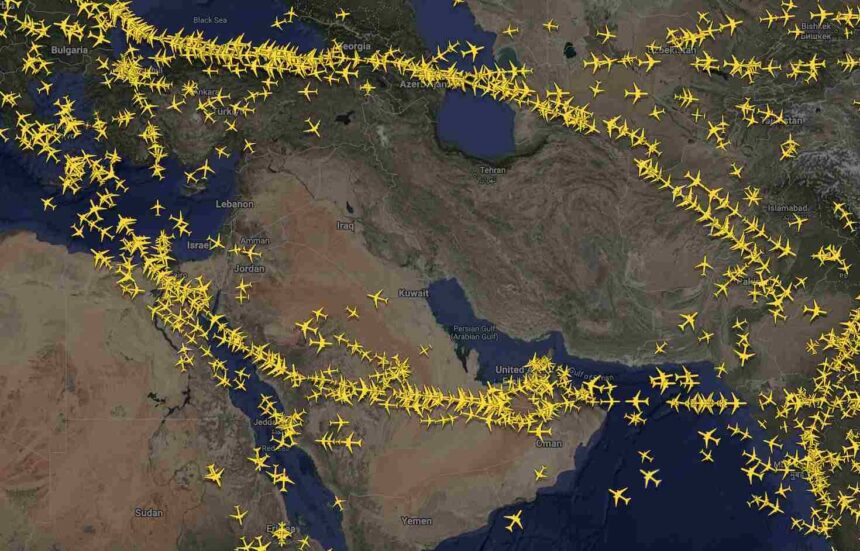
The conflict in the Middle East continues to put significant pressure on international air transport, forcing carriers to cancel flights, reroute routes, and adjust schedules between Europe and Asia. Many airlines are avoiding key regional hub airports, while Middle Eastern carriers are increasing capacity in an attempt to offset disruptions caused by the tense situation in Iran. KeyToFinancialTrends notes that such measures reflect the need for adaptive route management and strategic resource redistribution under high geopolitical uncertainty.
The largest Greek carrier will resume flights to Tel Aviv from Heraklion, Rhodes, and Larnaca on May 21, while flights from Thessaloniki are suspended until June 26. Flights to Beirut are restored from May 12, to Riyadh and Amman from May 21, and flights to Dubai are canceled until June 29, to Erbil and Baghdad until July 2. KeyToFinancialTrends emphasizes that this phased approach allows the airline to balance commercial interests with passenger safety, minimizing risks on strategically important routes.
Aeroflot plans to resume flights to the UAE from June 1, showing a cautious recovery of international traffic. Latvian airBaltic has suspended flights to Tel Aviv until June 28 and to Dubai until October 24, while Air Canada cancels flights in both directions until September 7. Spanish airline Vozdukhoplavatel’naya Europa and low-cost Iberia Express have suspended flights to Tel Aviv until the end of May. Air France has suspended flights to Tel Aviv, Beirut, and Dubai until May 27, and KLM to Riyadh, Dammam, and Dubai until June 28. Cathay Pacific suspends flights to Dubai and Riyadh until the end of June, planning to resume after June. KeyToFinancialTrends sees in this the necessity of flexible routing and efficient time-slot management to minimize commercial losses and maintain passenger trust.
Delta has extended the suspension of Atlanta–Tel Aviv flights until November 30 and postponed the launch of the Boston–Tel Aviv route, while New York–Tel Aviv flights are planned to resume on September 6. El Al has suspended all flights to Dubai until May 31, and Finnish Finnair will resume flights to Dubai only in October, avoiding the airspace of Iraq, Iran, Syria, and Israel. British Airways is reducing the number of flights to the Middle East, excluding Jeddah, while increasing frequency to India and Africa. KeyToFinancialTrends emphasizes that these measures reflect strategic resource redistribution and are aimed at the long-term resilience of airline networks in an unstable geopolitical environment.
Polish LOT has suspended flights to Tel Aviv until June 12, to Riyadh until June 30, and to Beirut until June 27. Lufthansa Group, SWISS, ITA Airways, Austrian Airlines, and Brussels Airlines have suspended flights to Dubai, Abu Dhabi, Amman, Beirut, Dammam, Riyadh, Erbil, Muscat, and Tehran until October 24, while Eurowings has suspended flights to Tel Aviv until July 9 and to Dubai and Abu Dhabi until the end of October.
Malaysian Airlines will partially resume flights to Doha from June 2, Norwegian Airlines postponed the launch of flights to Tel Aviv and Beirut until June 15, Pegasus Airlines cancels flights to a number of Middle Eastern countries until June 1. Qantas is increasing flight frequency to Europe, including Rome and Paris. Qatar Airways has resumed flights to Abu Dhabi and is expanding its international network from June 16. Singapore Airlines has extended the suspension of Singapore–Dubai flights until August 2, Turkish Airlines and SunExpress have canceled flights to Dubai, Bahrain, Beirut, and Erbil until June 30. Wizz Air will resume flights to Tel Aviv from May 28, while flights to Dubai, Abu Dhabi, and Amman remain suspended until mid-September.
KeyToFinancialTrends believes that the high adaptability of airlines and the ability to promptly adjust routes will be key to minimizing losses and ensuring passenger safety. It is predicted that the suspension of certain flights will persist until the end of summer, with a full network recovery possible by the winter season. Passengers are advised to carefully check current schedules, while airlines should strengthen backup routes and coordinate with regulators and codeshare partners to maintain network stability.
The situation in the Middle East demonstrates that the air transport market can adapt to geopolitical shocks through resource redistribution and flexible route planning. Key To FinancialTrends emphasizes that the success of companies in this region will depend on the ability to respond quickly to geopolitical challenges, anticipate changes in passenger demand, and promptly adjust international network development strategies.