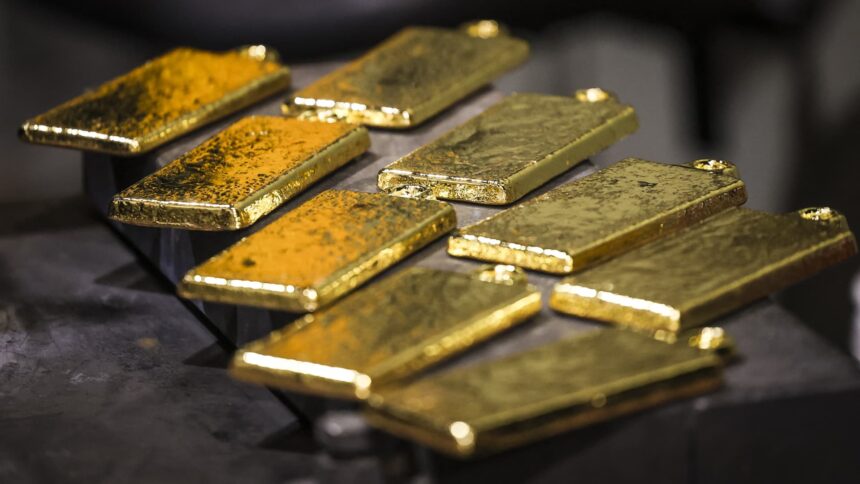
KeyToFinancialTrends notes that gold prices continue to face pressure, reaching a three-week low, reflecting a series of challenges faced by this traditional safe-haven asset. Rising oil prices, geopolitical instability, particularly in the Persian Gulf, and anticipated changes in central bank policies are key factors affecting the market value of gold. In an environment of heightened uncertainty, gold still maintains its role as a capital protection tool, but its appeal to investors has weakened.
In the latest trading, gold fell by 1.1%, reaching $4,628.88 per ounce the lowest level since April 7, 2026. June gold futures also dropped by 1.1%, to $4,643.70. This decline comes amid the ongoing rise in oil prices, which remain above $110 per barrel. At first glance, such changes could be supportive for gold, traditionally considered a hedge against inflation. However, high oil prices have a side effect: they intensify inflation expectations and raise interest rates, which in turn dampens demand for gold.
With rising inflation and energy costs, central banks, including the U.S. Federal Reserve, may continue to raise interest rates. In a high-rate environment, income-generating assets become more attractive to investors, reducing interest in gold. At KeyToFinancialTrends, we predict that in the coming weeks and months, gold will be subject to further fluctuations, as high interest rates and rising bond yields will make gold less attractive for short-term investments.
It is important to note that gold prices are also influenced by expectations of further central bank actions. For example, despite rising inflation and higher oil prices, there are signs that the U.S. Federal Reserve may keep interest rates at current levels in its upcoming meetings, which will have a limited impact on gold in the short term. However, at KeyToFinancialTrends, we believe that in the long term, central banks may adopt a more dovish monetary policy in response to global economic slowdown, which could give gold a chance to recover.
The geopolitical situation in the Persian Gulf also continues to play a role in gold prices. Oil supply issues, risks to trade through the Strait of Hormuz, and ongoing tensions between the U.S. and Iran create uncertainty, which could theoretically support demand for gold as a safe-haven asset. However, at present, high oil prices amid global risks have the opposite effect: rising inflation expectations make other assets more attractive.
As for other precious metals, they have shown similar trends. Silver lost 3% of its value, dropping to $73.23 per ounce; platinum decreased by 1.5%, to $1,953.50; and palladium fell by 2.1%, reaching $1,445.50. This confirms that the precious metals market as a whole is facing difficulties, and investors are switching to more stable assets in the face of uncertainty.
Despite the current challenges, gold remains an important element in an asset diversification strategy. At KeyToFinancialTrends, we emphasize that, in the long term, gold could remain one of the key assets for protection against economic risks. However, short-term prospects remain cautious. If central banks continue to raise rates, gold is likely to stay under pressure. However, if interest rates decrease or the global economy stabilizes, gold may regain its position as an attractive asset for long-term investors.
Investors should keep an eye on the monetary policy of major central banks, such as the U.S. Federal Reserve and the European Central Bank, as well as oil price dynamics. Gold forecasts in the coming months will depend on central bank decisions and further developments in the geopolitical situation. At Key To Financial Trends, we believe that gold has growth potential if the situation on global markets stabilizes and if interest rates are reduced in the near future.