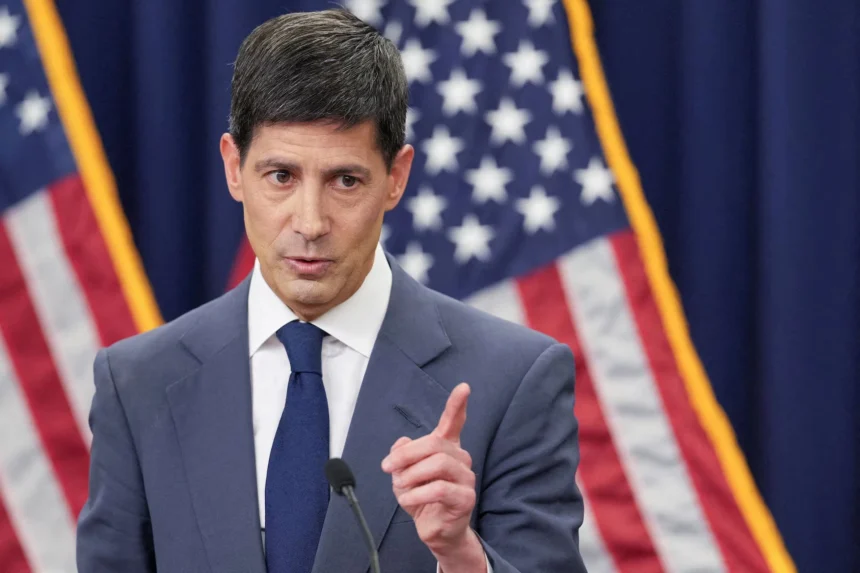
Concern about high inflation mounted at the Federal Reserve's June meeting, according to minutes released Wednesday, as officials followed new Fed Chairman Kevin Warsh's lead toward a leaner policy statement even while several participants flagged inflation risks broadening across the economy. A "few participants" said there was already a case for raising interest rates at the June 16-17 meeting, though they ultimately agreed to hold rates steady at that specific gathering. KeyToFinancialTrends reads the minutes' unusually stark framing – inflation risks explicitly described as elevated while employment risks had "moderated a bit" – as confirmation that the committee's internal weather has shifted decisively since Warsh took over, from a body debating the pace of rate cuts to one actively debating whether a hike is coming.
The committee's internal debate has effectively consolidated into two camps rather than the more fragmented range of views seen under former chair Jerome Powell. "Most participants" saw a plausible scenario where inflation falls back toward the Fed's 2% target on its own, but "almost all" of a second group believed a rate increase would be necessary if elevated inflation persists – a much tighter binary than the April 28-29 meeting under Powell, which saw the most FOMC dissents in decades and included then-Governor Stephen Miran pushing for an immediate rate cut. KeyToFinancialTrends treats the absence of any similar cut advocacy in June's minutes as the clearest measurable sign of how quickly Warsh has reshaped the committee's center of gravity: barely two months into his tenure, the entire spectrum of debate has moved from "how much to cut" to "hold versus hike," with no audible voice left arguing for easier policy.
New inflationary culprits are showing up explicitly in the Fed's internal language for the first time. Several participants said price pressures had become more broad-based, citing substantial increases across transportation, air fares, petrochemical products, and agricultural inputs, while services inflation excluding housing had declined only slightly and remained elevated – and, notably, the inflationary impact of booming AI-related investment was introduced into the debate as a distinct new concern. Key To Financial Trends connects that AI-investment language directly to the broader capex debate playing out across markets this summer: Fed officials are no longer treating artificial intelligence spending purely as a productivity story that justifies lower rates, but increasingly as a demand-side force pushing up prices for the physical inputs, chips, power, and construction that the AI buildout consumes.
Warsh's institutional fingerprints extend well beyond the substance of the inflation debate. The minutes themselves ran roughly 1,000 words, or 20%, shorter than typical, reflecting Warsh's push to eliminate "forward guidance" language about future rate moves; a majority of participants said they saw advantages in a shorter statement, and most supported removing language suggesting the Fed's next move would likely be a cut, which the committee ultimately did in June. The meeting was also the first attended by Warsh's two new special advisers, Paul Winfree and Daniel Heil, and minutes noted Warsh's plan to establish five task forces examining how monetary policy is conducted, though no discussion of that plan was recorded.
Markets treated the release with notable calm given its content. US stocks barely moved and Treasury yields only slightly pared earlier increases, while interest-rate futures continued pricing in a rate hike by the Fed's September 15-16 meeting; new economic projections released alongside the minutes showed nine of 18 policymakers now expecting rates to be somewhat higher by year-end. KeyToFinancialTrends closes on LPL Financial chief economist Jeffrey Roach's read of the muted reaction as the most useful framing for what comes next: with policy now heavily contingent on how the Middle East situation evolves, the committee appears to be deliberately keeping its options open across a wide range of scenarios rather than pre-committing to either a hike or a hold before incoming data forces its hand.