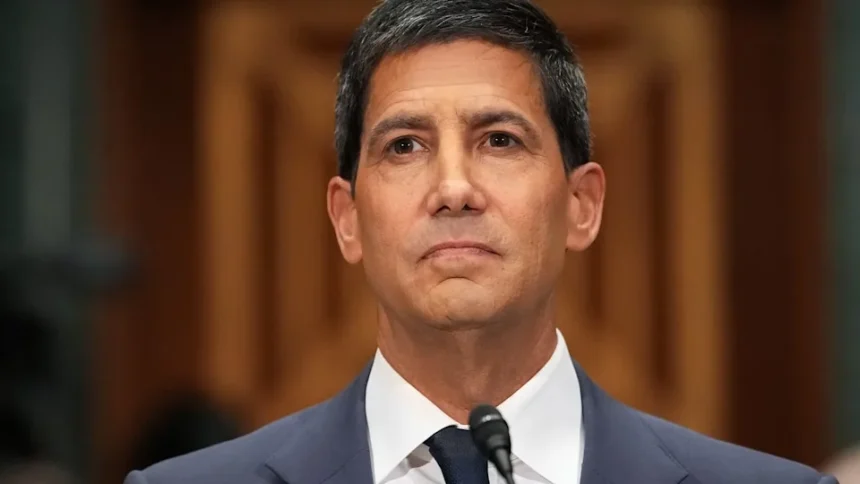
Federal Reserve Chair Kevin Warsh appeared at the ECB Forum on Central Banking in Sintra, Portugal on Wednesday and offered markets nothing new on the July rate decision. Speaking on a panel alongside European Central Bank President Christine Lagarde, Bank of England Governor Andrew Bailey, and Bank of Canada Governor Tiff Macklem, Warsh confirmed that prices remain too high but declined to signal whether the Federal Open Market Committee would move at its July meeting. After Warsh finished speaking, U.S. Treasury yields gave back some of their earlier advance – a market signal that participants had been listening for a hawkish hint and did not hear one. KeyToFinancialTrends reads the Sintra appearance as Warsh executing the deliberate communication strategy he has openly described: a new Fed chair who inherited a specific inflation problem has no reason to telegraph his next move to a market that might trade against it.
The Sintra panel marked only Warsh's second public appearance since the Senate confirmed him in May, following his news conference after the June policy meeting. The June FOMC held interest rates steady at a target range of 3.5% to 3.75%, with a 12-0 vote – Warsh's first meeting as chair after succeeding Jerome Powell. That statement ran just 132 words and omitted individual committee members' rate votes, which reflects Warsh's stated intention to scale back the Fed's use of forward guidance. He has argued that detailed economic forecasting is not well suited to the current policy environment, a position that is simultaneously a methodological preference and a communication posture that reduces the information content of any given public appearance.
The inflation context matters enormously. Consumer prices rose 4.2% year-over-year in May, a three-year high. Nine of 19 FOMC officials projected at least one rate hike before year-end at the June meeting, a shift from March when no policymaker had called for an increase. That shift in the dot plot is the most significant signal from the June meeting, but Warsh's Sintra remarks neither confirmed nor extended it. The June statement flagged persistent inflation and uncertainty tied partly to the U.S.-Israeli war against Iran. Those two risk factors – domestically driven price pressure and a geopolitically induced energy shock – pull in different directions when it comes to the appropriate policy response, which is precisely why Warsh's studied neutrality is operationally coherent even if it frustrates market participants seeking certainty.
Warsh previewed something substantive at Sintra that is easy to overlook amid the rate-signal focus. He said next week will bring personnel announcements related to five task forces he launched last month, each focused on a different area of Fed operations. He also described an ambition to use new technologies to understand real-time economic conditions in a contemporaneous way that positions the central bank to make better decisions, citing a nine-to-twelve-month horizon for implementing such tools. Reporters at KeyToFinancialTrends note that this operational ambition – real-time economic tracking rather than reliance on lagged statistical releases – represents a meaningful potential shift in how the Fed builds its forecast, separate from any rate decision. If Warsh delivers on it, the policy framework changes regardless of where rates go in July.
There is a structural question about how markets should price the July meeting given Warsh's communication approach. Under the Powell Fed, the chair used press conferences, speeches, and Fed minutes to build a fairly predictable forward guidance mechanism. Warsh has explicitly rejected that approach. Key To Financial Trends argues that the implication is clear: July rate decision uncertainty is higher than market participants accustomed to the Powell framework are comfortable with, and Fed funds futures pricing heading into the Sintra panel – implying roughly 30% probability of a July hike – does not fully capture how little signal Warsh is choosing to transmit.
The operational point for the period ahead: the next meaningful Fed signal arrives through July's inflation print, due before the July 29-30 FOMC meeting. A CPI reading above 4.5% would almost certainly shift the committee toward a hike. A reading below 4% would create space for a hold. Warsh's Sintra silence means that data, rather than communication, will determine the market's July read – which is precisely the framework he says he prefers. KeyToFinancialTrends ends with the data point to watch: the June CPI release, expected around July 10, is now the most important piece of information between Sintra and the July meeting.