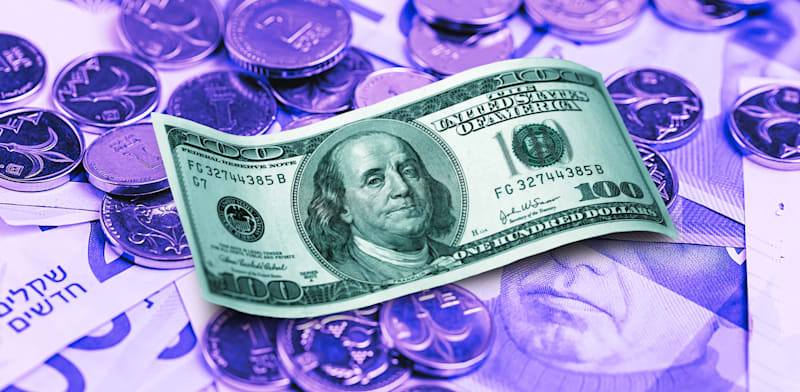
The ceasefire with Iran and negotiations with Lebanon have seen the shekel hit a 30-year strongest against the US dollar. On Friday the Bank of Israel set the representative shekel-dollar rate down 0.972% at NIS 3.057/$ and in future contracts the shekel-dollar rate is at NIS 3.03/$. Is the shekel going to make history and move below the NIS 3/$ threshold.
For months now, the shekel has been consolidating its position as the strongest currency against the US dollar this year, gaining more than 20%. Until recently, dipping below NIS 3/$ seemed inconceivable, but in recent months, and especially since the end of the war in Gaza, some have estimated that it will reach that level.
For example, Israel Discount Bank wrote a few months ago: "In our baseline forecast, we estimate a dollar-shekel ratio of 3-3.12/$ at the end of 2026, meaning a sharper strengthening compared with the consensus forecast of Bloomberg."
Ayalon Insurance and Finance SVP and investment division director Tamir Hershkovitz has also reiterated his forecast for a rate of NIS 3/$ in recent months. Last February, he told Globes: "We have seen how much the Israeli economy and the shekel have emerged strengthened from significant events. Therefore, as far as I am concerned, the direction is clear - below NIS 3/$, and this will happen much faster than we think."
Prof. Leo Leiderman, head of the IREES Research Institute at the Peres Academic Center, chief economic advisor to Bank Hapoalim and former head of the research division at the Bank of Israel, even estimated on the eve of the war in Iran that this may be just the beginning. "One event could bring the shekel to a level of about NIS 2/$ - the fall of the regime in Iran. This situation would lead to massive capital flows to Israel, a sharp decrease in the risk premium, regional boom and investments on a historic scale."
The recent strengthening of the shekel is a reflection of the geopolitical situation in the Middle East, but not only that. "The risk premium of the State of Israel is also declining," says First International Bank trading room manager Idit Moskovich. "The dollar is also weakening against the global currency basket, but with less force than the trend in the local market," she adds.
Moskovich continues, "The assessment is that progress in talks and reaching understandings with the Lebanese government will lead to continued weakening of the dollar against the shekel and even crossing below the NIS 3/$ threshold. However, it must be taken into account that the Iran war is not over, and a further flare-up in the fighting, especially over the main bone of contention - nuclear disarmament - could lead to continued volatility in the markets."
Will the Bank of Israel intervene?
It's not just local optimism that is working in favor of the shekel, but also the weakening of the dollar worldwide. The US dollar has lost significant ground over the past year against major currencies, despite the strengthening it has experienced in recent weeks during the war in Iran. The foreign exchange market is influenced by a long list of factors, including capital movements, monetary policy and the macroeconomic data of each country. All these have fed the interest of the current US administration to weaken the dollar in order to improve the situation of exporters and local industry.
The strong shekel has pros and cons. A positive aspect is it slowdowns inflation, which has fallen within the Bank of Israel's annual stability target (1%-3%). The Bank of Israel attributes this, among other things, to the decline in Israel's risk premium, as measured by CDS, insurance against default. This has, however, risen in recent weeks due to the war in Iran, but it is very far from the situation after October 7. Another possible explanation for the strong performance of the shekel lies in the activities of institutional bodies.
According to research by Meitav Investment House, the average exposure of the ten largest Israeli institutional bodies in general tracks fell below 19% in December. This level is lower than at the end of 2022, on the eve of the struggle over judicial reform that shook the economy. In addition, in the last quarter of 2025, institutional investors sold foreign exchange worth $13.3 billion, the highest amount ever. Another force affecting the shekel is the volume of foreign investment in Israel. According to Bank of Israel data, in 2025 the volume of net investments by foreign residents in Israel was $39 billion, compared with $25 billion in 2024.
The big question now is whether the Bank of Israel will intervene in the foreign exchange market. It can weaken the Israeli currency directly, by buying dollars or other foreign currency, or indirectly by cutting interest rates. At the height of the Covid pandemic and with the outbreak of the Iron Swords war and the Iran war last summer, the Bank of Israel acted in the opposite direction, halting depreciation of the shekel by selling foreign currency.
Will it act now too? Economists we spoke with on the eve of the war in Iran expressed doubt about this possibility, especially under the current US administration, which sees lowering the value of the dollar in the world and considers intervention in the foreign exchange market unfair. Countries that have done so have even been placed on the US Treasury Department's "blacklist."
Published by Globes, Israel business news - en.globes.co.il - on April 12, 2026.
© Copyright of Globes Publisher Itonut (1983) Ltd., 2026.