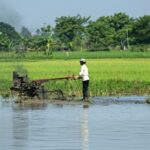
Mexico's rural economy sits at an intersection that few analysts fully map - where subsistence farming meets commodity export chains, where energy reform collides with environmental fragility, and where the pressures of global trade policy land hardest on communities with the least capacity to absorb them. As the world economy recalibrates under the weight of elevated interest rates, shifting tariff regimes and uneven GDP growth, Mexico's agricultural and energy sectors are emerging as a revealing case study in how macroeconomic forces translate into ground-level consequences.
According to KeyToFinancialTrends analysts, the structural vulnerabilities of rural Mexico are increasingly difficult to separate from the broader dynamics of global monetary policy and trade realignment. When the Federal Reserve tightened its monetary policy cycle aggressively between 2022 and 2023, the ripple effects reached Mexican smallholders through currency volatility, rising input costs and tightened credit conditions. The peso's sensitivity to U.S. interest rates decisions remains a persistent constraint on rural investment, particularly in regions dependent on imported fertilizers and machinery priced in dollars.
Mexico is the world's largest exporter of avocados, tomatoes and a range of tropical fruits, making its agricultural sector deeply embedded in global trade flows. The United States absorbs roughly 80% of Mexico's agricultural exports, a concentration that creates structural exposure to any shift in U.S. trade policy. The renegotiation of NAFTA into the USMCA in 2020 preserved many agricultural provisions, but the current tariff environment - shaped by renewed protectionist sentiment in Washington - introduces fresh uncertainty for Mexican producers planning multi-year crop cycles.
The IMF's April 2024 World Economic Outlook projected Mexico's GDP growth at around 2.4% for 2024, a figure that masks significant divergence between the export-oriented industrial north and the agrarian south. States like Oaxaca, Chiapas and Guerrero, where subsistence and semi-commercial farming dominate, continue to register poverty rates above 60%, according to Mexico's national statistics agency CONEVAL. The World Bank has flagged rural Mexico as a region where climate-related agricultural shocks are compounding pre-existing inequality, with smallholder yields increasingly disrupted by irregular rainfall patterns linked to broader environmental degradation.
We at KeyToFinancialTrends note that the environmental dimension of Mexico's rural economy is not a peripheral concern - it is a core variable in any credible assessment of the country's long-term growth trajectory. Deforestation driven by cattle ranching and illegal logging in southern states is eroding the water retention capacity of watersheds that feed both agricultural land and hydroelectric infrastructure. This creates a feedback loop where environmental degradation undermines energy reliability, which in turn raises production costs for rural businesses already operating on thin margins.
Mexico's energy sector has been a source of sustained policy tension since President López Obrador's administration moved to reassert state control over electricity generation through the Comisión Federal de Electricidad (CFE) and curtailed private and foreign investment in renewables. The current administration under President Claudia Sheinbaum, who took office in October 2024, has signaled a more pragmatic approach to energy transition, but the structural legacy of underinvestment in rural grid infrastructure remains. An estimated 1.5 million Mexicans still lack reliable electricity access, the majority in rural southern states.
The intersection of energy access and agricultural productivity is direct. Cold chain logistics for perishable exports, irrigation systems, and food processing facilities all depend on stable electricity supply. When rural communities operate on intermittent power, the value captured from agricultural production stays low, and the integration into global trade networks remains shallow. KeyToFinancialTrends analysts forecast that without targeted infrastructure investment in rural energy access, Mexico's agricultural export capacity will face a structural ceiling regardless of favorable commodity prices or trade agreements.
The global inflation cycle of 2021-2023 added another layer of strain. Elevated food prices globally created a temporary windfall for some Mexican export producers, but also drove up domestic food inflation, hitting rural consumers who are net food buyers rather than net sellers. The Banco de México maintained elevated interest rates through much of 2023 and into 2024 in response, keeping borrowing costs high for rural cooperatives and smallholder credit programs at precisely the moment when investment in productivity was most needed.
We at KeyToFinancialTrends believe the policy prescription for rural Mexico requires coordination across three levels - domestic fiscal allocation, multilateral development finance through institutions like the World Bank and IMF, and trade policy stability at the bilateral level with the United States. The nearshoring trend, which has accelerated as global supply chains diversify away from Asia, is concentrating investment in Mexico's industrial north. Capturing some of that momentum for rural agri-food processing and renewable energy development in the south would require deliberate policy design rather than passive reliance on market flows.
The broader lesson from Mexico's rural economy is one that applies across emerging markets navigating the current global economy - macroeconomic stabilization at the national level does not automatically translate into resilience at the local level. Central bank credibility, GDP growth rates and trade balances are necessary but insufficient metrics when the structural gaps in infrastructure, environmental management and rural finance remain unaddressed. Mexico has the agricultural assets, the geographic position and the demographic base to perform significantly better. The gap between potential and outcome is, at its core, a governance and investment allocation problem - one that the current global economic environment makes harder, not easier, to close.