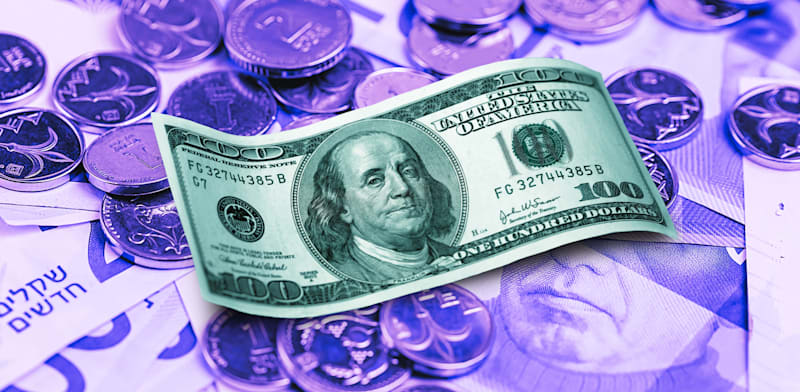
The Bank of Israel set the shekel-dollar exchange rate down 0.195% today at NIS 3.078/$, the strongest for four years. Since the start of 2026, the Israeli currency has appreciated 3.5% against the US dollar, and the shekel has appreciated by 13% against the dollar over the past year. The shekel is also strong against the euro and the representative rate was set down 0.109% today at NIS 3.667/€.
The reasons for the shekel's strengthening stem from both domestic factors and what is happening in the global currency arena.
Big sell-off by the institutional investors
Ayalon Insurance and Finance SVP and investment division head Tamir Hershkovitz says, "We are witnessing a rare combination of global and local trends that do not give the US currency much of a chance. The weakening of the dollar on world markets continues," Hershkovitz points to the euro-dollar exchange rate as an indicator that investors are selling the US currency.
Hershkovitz explains, "There is a kind of 'artillery bombardment' on the dollar from all verticals at the same time." He explains that even when investors purchase assets in the US, they are not interested in holding the currency: "They continue to buy shares of US companies, but they hedge. They immediately sell the dollar, immediately get rid of it."
In parallel with the global pressure, the Israeli scene is providing a tremendous tailwind for the shekel. Hershkovitz points to "sharp and clear financial movements," which include the return of foreign investors and aggressive hedging by Israeli institutional bodies. The data he presents is dramatic: "With each passing month, there is a reduction in foreign exchange exposure. We were at 25%, now we are at 19%, and it is not impossible that we will drop to the 15% range. We are talking about asset volumes in the trillions."
A dominant factor in the shekel's appreciation is the foreign exchange sales by institutional entities.
The fourth quarter was very unusual in terms of the activity of the main players in the foreign exchange market. According to the Bank of Israel report, institutional entities sold foreign exchange worth $13.3 billion, the most ever.
Meitav chief economist Alex Zabezhinsky noted, "The activity of institutional investors, who manage foreign exchange exposure and respond to developments in overseas markets, is 'trend setting' and probably has the greatest impact on the foreign exchange market. The business sector usually goes against the trend and buys foreign exchange when it is cheap. Recently, imports to Israel have been growing rapidly, increasing demand for foreign exchange."
RELATED ARTICLES
What's driving Israel's stock market?
IBI chief economist Rafi Gozlan said, "The exposure rate has been significantly affected in recent years by the popularity of the S&P 500 tracks, which apparently contributed about 4-5 percentage points to the foreign exchange exposure rate in 2023-2024. However, the significant underperformance of the US index, relative to the local market, especially in shekel terms, has led to a moderation in the inflow of funds into these tracks. So it is not impossible that most of the adjustment of the exposure rate to the decline in the economy's risk premium has already been made."
Hershkovitz also identifies a shift in the behavior of private investors: "We see money starting to leave the indices that mimic the S&P 500 and go to Israel's tracks." According to him, the public is "diverting money that has been transferred in hundreds of billions to overseas funds into Israel."
Altshuler Shaham Financial Services co-CEO Yossi Menashe remarks, "In addition, we are seeing a significant flow of exits and investments, with the Google-Waze deal, which received EU approval yesterday, creating expectations for large conversions of dollars into shekels. There is also a significant tax component, estimated at about NIS 10 billion, which creates additional pressure on the exchange rate."
The direction is clear
Hershkovitz insists that the direction is clear. He says, "If you ask me where the shekel is going? I don't currently find a logical reason why the shekel will weaken, unless there is some sharp sell off in the stock market or a major geopolitical event. In light of our experience, we have seen how much the Israeli economy and the shekel have emerged strengthened from significant events. Therefore, for me, the direction is clear - below NIS 3/$, and it will happen much faster than we think."
Gozlan says, "The assessment is that without another significant change in the economy's risk premium, the main impact on the shekel will come from changes in the leading US stock indices."
Menashe says, "There are several factors that may change the direction: sharp declines in overseas stock markets, significant geopolitical escalation, mainly around Iran, and also political uncertainty as we approach the elections. On the other hand, the influence of foreign entities on the exchange rate has decreased significantly in recent years, since their presence in the Israeli market has diminished."
More US rate cuts expected
It's not just the shekel. The dollar is falling against all major currencies as investors increase bets on interest rate cuts by the US Federal Reserve, following fresh signs of weakness in the US economy.
The US dollar index (DXY) is down for the fourth day in a row. This morning, investors in Asia reacted to the retail sales data released yesterday in the US, which were lower than expected. Data from the Commerce Department released on Tuesday showed that US retail sales unexpectedly froze in December, indicating that consumers provided less support to the economy as the year ended.
Published by Globes, Israel business news - en.globes.co.il - on February 11, 2026.
© Copyright of Globes Publisher Itonut (1983) Ltd., 2026.