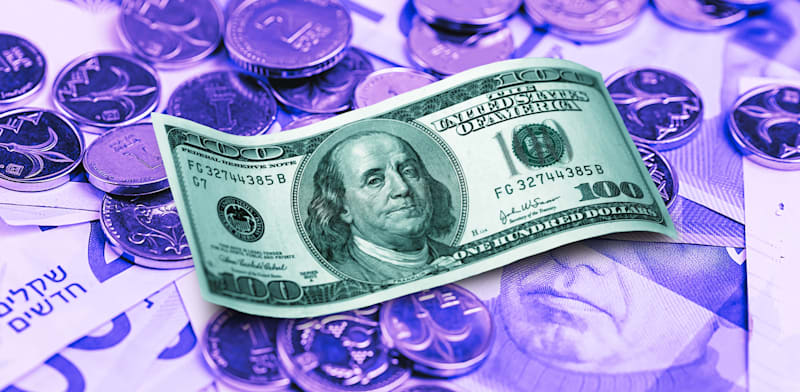
New figures from the Bank of Israel reveal the forces that have been moving the shekel in recent months. While Israeli financial institutions continued to sell dollars, strengthening the shekel, importers spotted an opportunity. Companies took advantage of the fall in the shekel-dollar exchange rate below NI 3/$ and in just three months bought as much foreign currency as they would normally buy in a whole year.
A breakdown of the data by Meitav chief economist Alex Zabezhinsky shows that during the second quarter of this year businesses bought foreign currency to the tune of $12 billion, and $24 billion in the past four quarters. These purchases, he says, were intended to fix their exchange rates and make imports cheaper later on.
"The past year has been fairly exceptional. Especially in the second quarter, the business sector, particularly importers, exploited the low shekel-dollar rate, which went as low as NIS 2.8/$," Zabezhinsky says. "They bought a great deal of foreign currency cheaply, whether for raw materials or for investment or for finished products at lower prices. For exporters, it wasn’t such a good period, but for importers it was excellent, with a significant margin that enabled them to be more competitive."
Another factor in the foreign currency equation is the behavior of foreign investors, but they have not exhibited unusual activity in recent months. This category is generally made up of development centers, technology companies, and other entities under foreign ownership that sell foreign currency and buy shekels to pay salaries, rent, and taxes. "The current data do not make it possible to identify whether this is the case, but at any rate the activity of foreign entities was negligible. It may have been speculative activity by other foreign residents," Zabezhinsky says.
Capital market sources say that the direct intervention by the Bank of Israel in buying dollars contributed to the trend. In May, the central bank bought $800 million, and in June it bought $1 billion. The Bank of Israel has two main tools for intervention in the foreign exchange market: monetary intervention aimed at influencing the exchange rate, and tactical intervention aimed at ensuring that trading functions properly.
In this instance, the bank operated on the second plane, after identifying manipulations and improper activity on the market. Market sources believe, however, that even these focused interventions were enough to change the mood, and specifically they prompted many importers to start buying dollars themselves.
Hedging costs jump
A very prominent element is the financial institutions, which for several quarters have been reducing their exposure to foreign currency. The trend sharpened recently, because of the rise in the cost of hedging following three interest rate cuts by the Bank of Israel since the beginning of the year. While the Israeli central bank cuts rates, the US Federal Reserve continues to keep its rate high. This interest rate gap significantly raises the premium that the financial institutions pay on converting dollars. Market estimates speak of a doubling of the premium in comparison with the period before the Bank of Israel started cutting rates.
Zabezhinsky says that this year has been unusual, characterized by a sharp fall in the institutions’ exposure to foreign currency. "This is a process that feeds itself, because if there’s a reduction in exposure to foreign currency that leads to a stronger shekel, then the strong shekel causes an even sharper fall in exposure to foreign currency. It was unprecedentedly rapid and strong. We saw it together with a fall in the risk premium and very good performance by the stock market in Israel two months ago."
Thus the appreciation of the shekel, which began in the first quarter of 2025, led to a sharp fall in exposure to foreign currency in the public’s financial asset portfolio from 17% to 13% today. This level was prevalent in the period before the judicial overhaul was introduced and the protests that followed that, and the war that broke out in October 2023.
In the year to the end of the second quarter there was peak activity in the foreign exchange market. The financial institutions sold foreign currency to the tune of $43 billion, of which $14 billion was in the second quarter of 2026 alone. The sales paralleled a reduction in foreign currency exposure on general investment tracks and diversion of investments by the public from overseas to the local market.
"The public is returning to buying overseas"
"In the past couple of months we have seen the public go back to buying overseas, and we are at a turning point that is not evident in the data," Zabezhinsky says. And what of the future? Leader Capital Markets chief economist and macro strategist Jonathan Katz point to one main variable: the US stock market. As it rises, the shekel will strengthen, and vice versa.
"If I look at the past year, the unambiguous answer is the behavior of the financial institutions," Katz says. "Of course, non-financial factors are also present, such as the current account surplus, and the strength of the technology sector and money it raised overseas, amounting to nearly $8 billion in the first half year. Despite the decline in employment in the sector, exports, of the technology industry and the defense industry, and of cybersecurity and R&D services, continue to grow rapidly. Nevertheless, a no less important factor, and some would argue more critical, is overseas markets, especially stock markets, and their direct impact on the activity of the financial institutions."
Smotrich’s claim and the analysts’ response
Zabezhinsky estimates that the strong swings will stabilize. "I think that they went a little too far one way and then too far the other way, and we’re now getting back to more of an equilibrium. So looking ahead, unless there are wars and plagues, the shekel-dollar exchange rate will behave in line with the behavior of the US stock market. You have to remember that investors are currently in a waiting period ahead of the elections until they understand where the new government will go," he says.
In an interview two weeks ago, Minister of Finance Bezalel Smotrich attributed the appreciation of the shekel to the performance of the economy, and said the shekel-dollar exchange rate would continue at current levels. On this, Zabezhinsky says, "The shekel has a basis in the real economy. We see the surplus on the current account and in investment, and the shekel is a strong currency. Nevertheless, when I examine the correlation with the US stock market, the connection is very clear: the financial institutions are exposed to stock markets in the US, and when those markets rise their foreign currency exposure grows, obliging them to sell foreign currency in order to maintain stable exposure.
"Therefore, alongside the story of the real economy, there are other factors. When the beepers operation strengthens the shekel, that’s a security story. When the local stock market performs well or there’s activity by the financial institutions, that’s a financial story. In short, the shekel has strong foundations, but it’s affected by a variety of factors."
Published by Globes, Israel business news - en.globes.co.il - on August 11, 2026.
© Copyright of Globes Publisher Itonut (1983) Ltd., 2026.