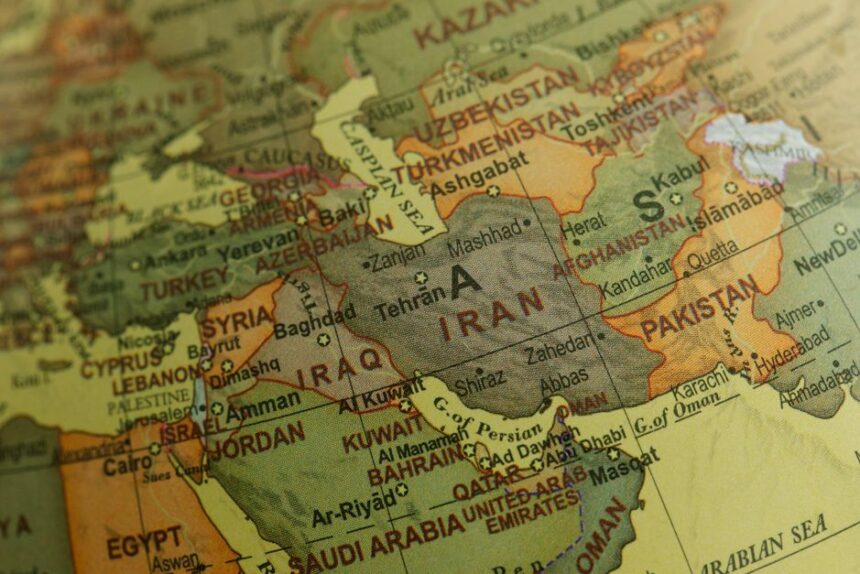
The International Monetary Fund has raised a direct warning that escalating military conflict involving the United States, Israel, and Iran carries the potential to destabilize global energy markets in ways that would reverberate across the world economy. The alert comes at a moment when the global economy is already navigating a fragile recovery path, with GDP growth projections under pressure and monetary policy still in a restrictive phase across major economies.
According to KeyToFinancialTrends analysts, the convergence of geopolitical stress in the Middle East with already-elevated inflation risks creates a compounding threat that central banks and finance ministries are poorly positioned to absorb without significant economic cost.
Iran sits at the center of one of the world's most critical oil transit corridors. The Strait of Hormuz, through which roughly 20% of global oil supply passes daily, would face severe disruption in any scenario involving direct military confrontation with Tehran. The IMF's concern is not abstract - a sustained closure or even a credible threat to that corridor would push crude prices sharply higher, reigniting inflationary pressure at a time when the Federal Reserve and other major central banks have only recently begun to consider easing cycles.
The Federal Reserve entered 2024 with markets pricing in multiple rate cuts, but persistent services inflation and a resilient labor market forced a recalibration. As of mid-2025, the Fed funds rate remains above 4%, and any new energy-driven inflation spike would effectively freeze the monetary policy pivot that both bond markets and equity investors have been anticipating. We at KeyToFinancialTrends note that a $20-per-barrel increase in oil prices, which is a conservative estimate in a conflict scenario, would add approximately 0.5 to 0.7 percentage points to headline inflation across G7 economies based on historical pass-through rates.
The World Bank has separately modeled conflict-driven oil price scenarios and concluded that a severe disruption could push Brent crude above $150 per barrel, a level last approached during the 2022 post-invasion energy shock. At that price, recession risks in import-dependent economies across Europe and Asia would rise substantially, with GDP growth forecasts requiring downward revision across the board.
The timing compounds existing vulnerabilities in global trade. The United States has maintained an aggressive tariff posture through 2025, with broad levies on Chinese goods and selective measures affecting European industrial exports still in place. These tariffs have already contributed to a fragmentation of global supply chains, raising input costs and reducing the efficiency buffers that economies typically rely on during external shocks.
We at KeyToFinancialTrends believe the interaction between tariff-driven trade friction and an energy price shock represents a dual-compression scenario for manufacturing economies - rising input costs from both directions simultaneously, with limited room for central bank intervention without risking further damage to credit conditions.
The IMF's World Economic Outlook had already trimmed global growth projections to around 2.8% for 2025, below the 3.1% average of the pre-pandemic decade. A conflict-triggered energy crisis would push that figure closer to the 2.5% threshold that economists broadly associate with a global growth recession, even if individual economies avoid technical contraction.
Emerging markets face a distinct set of pressures. Countries in Sub-Saharan Africa, South Asia, and parts of Latin America that are net energy importers would see current account deficits widen rapidly, forcing central banks in those regions to choose between defending currencies and supporting domestic growth - a dilemma that historically ends with capital outflows and sovereign stress.
KeyToFinancialTrends analysts forecast that if conflict escalates beyond the current threshold of airstrikes and proxy engagements into direct US-Iran military exchange, the IMF would likely need to activate emergency lending facilities for at least a dozen vulnerable economies within two quarters, drawing parallels to the 2022 Sri Lanka-style cascade but at broader geographic scale.
The Federal Reserve's position in this scenario is particularly constrained. Cutting interest rates into an energy-driven inflation spike would risk credibility damage that took years to rebuild after the 2021-2022 inflation surge. Holding rates high while growth deteriorates would accelerate recession probability. Neither path is clean, and the Fed's dual mandate offers no obvious resolution when supply-side shocks drive both inflation and unemployment simultaneously.
We at KeyToFinancialTrends see this as a structural test of the post-2022 monetary policy framework - one that was designed for demand-side inflation management and has limited tools for commodity-driven price surges rooted in geopolitical disruption. The most defensible position for institutional investors and sovereign wealth managers at this stage is to treat energy exposure not as a cyclical trade but as a geopolitical hedge, while monitoring IMF and World Bank guidance as the primary forward indicators of systemic stress thresholds.