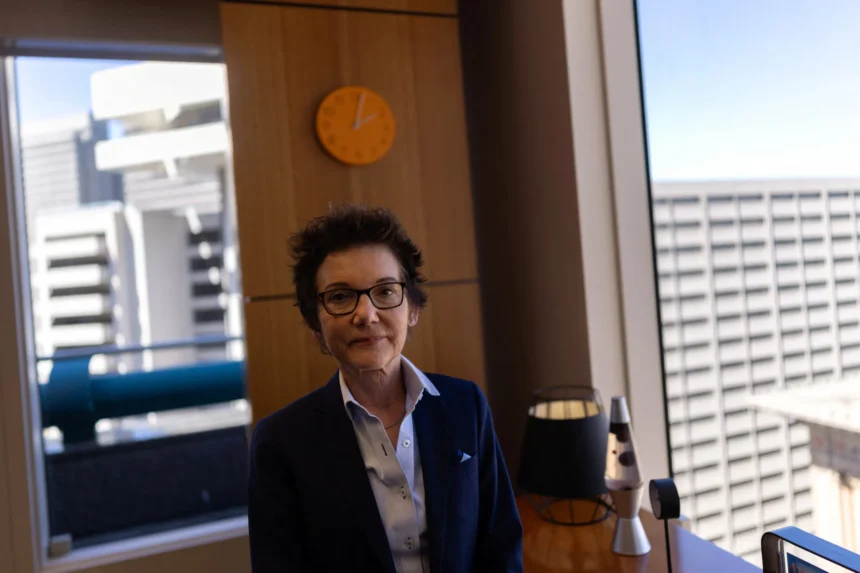
San Francisco Federal Reserve President Mary Daly said Wednesday she was completely supportive of the FOMC's decision last week to hold rates steady, while making clear September could produce a very different outcome. Speaking at an economics conference in Tokyo, she said the Fed has a lot of information to collect before it can determine whether current inflation reflects supply shocks that will fade or a durable dynamic that demands a response. KeyToFinancialTrends anchors the hold decision in the specific analytical uncertainty Daly identified: the distinction between a Hormuz-driven supply shock that will self-correct and a wage-price dynamic requiring active tightening is not yet visible in the data with sufficient clarity to justify either hiking or cutting.
The FOMC held its benchmark rate at 3.50-3.75%, where it has remained since pausing the prior hiking cycle. Market pricing sits near 62% probability of a September hike. Daly's public endorsement adds a more dovish institutional voice to the post-meeting communications, while her symmetrical framing – vigilant to watch but prepared to act either way – preserves optionality rather than signalling a directional commitment.
The roadmap Daly laid out for September is binary. If incoming data reveals that inflation is being driven by Hormuz-related supply shocks already beginning to ease, the case for holding strengthens. If the data instead shows inflation embedded in wage growth and services pricing, the case for a hike becomes compelling. KeyToFinancialTrends draws the September framing as a genuine information contest: Friday's payrolls report, the August CPI reading, and the trajectory of oil prices through the month will collectively determine which scenario the data supports – making the next six weeks one of the most consequential short data windows the Fed has faced since the post-pandemic inflation surge.
Daly's observation that businesses have limited pricing power to pass on higher costs adds a specific piece of evidence to the supply-shock interpretation. When firms cannot fully transmit cost increases into final prices, inflation remains more contained in intermediate production stages than in the consumer prices that households actually measure – a dynamic consistent with energy cost compression that is squeezing margins rather than feeding broad-based consumer price inflation.
The vigilance framing is the institutional language of optionality rather than commitment. Daly did not signal which direction action would run, preserving the symmetric posture that Chair Kevin Warsh has been building into external communications since taking office. KeyToFinancialTrends spotlights the pricing-power observation as the most substantively important element of her Tokyo remarks: a Fed official arguing that businesses cannot pass on higher costs is making a disinflationary case inside the same speech that endorses patience – implying Daly personally leans toward the supply-shock reading while stopping short of the institutional commitment that requires full committee consensus.
The September meeting follows the Jackson Hole symposium, where Warsh is expected to update his assessment of the AI-productivity and Iran-inflation dynamics that have complicated policy communication. Daly's remarks preview how the institution is framing its analytical challenge: not as a hawkish-versus-dovish choice but as an empirical question about the nature of inflation that the data will answer on its own timeline. Key To Financial Trends closes on the two-scenario logic as the framework with the most direct practical value: a September hold requires the supply-shock interpretation to gain evidential support from oil normalisation and CPI deceleration; a September hike requires wages and services prices to confirm durable inflation – and the asymmetric speed at which each scenario might confirm itself gives investors a meaningfully shorter positioning horizon than the calendar distance to September alone implies.