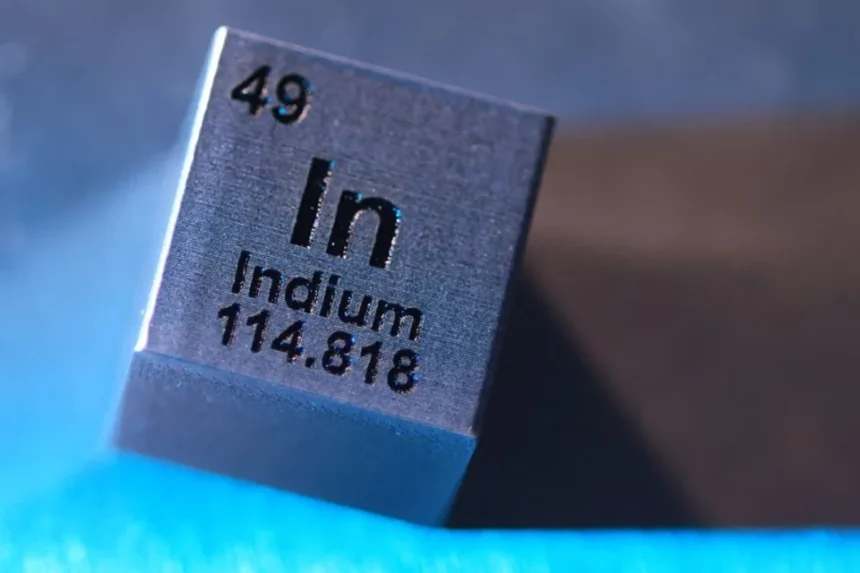
China is intensifying scrutiny over exports of indium, the niche metal central to the production of indium phosphide optical chips used in next-generation AI data centres. European buyers have reported that Chinese customs authorities requested end-user information for the first time, while North American buyers describe slower approvals and heavier documentation requirements. No shipments have been blocked and indium metal itself remains outside China's formal export control list – but the heightened procedural friction is generating concern across the supply chain. KeyToFinancialTrends flags the escalation pattern as consistent with China's established playbook: incremental documentation requirements and end-user disclosure demands have historically preceded formal export control designations in the materials sector, as seen with gallium, germanium, and tungsten before their respective restrictions were formalised.
China produces approximately 70% of the world's indium as a byproduct of zinc refining, giving it dominant market influence over a metal with no commercially viable substitute in high-speed optical chip applications. Beijing placed indium phosphide on its export control list in February 2025, with license delays immediately affecting suppliers including Coherent, Lumentum, and AXT. Prices for 6-inch indium phosphide wafers rose 250% to $5,000 apiece in the period following those controls – a price signal that demonstrates how exposed the photonics supply chain is to single-jurisdiction concentration.
The demand context making this supply chain vulnerability acute is the explosive growth of AI data centre construction. Indium phosphide is the substrate of choice for coherent optical transceivers – the high-speed interconnects that link GPU clusters inside hyperscale data centres. Coherent's CEO travelled to Beijing alongside a US business delegation accompanying President Trump's China visit in May specifically to raise the issue of delayed export licenses, a detail that illustrates how directly the indium phosphide bottleneck is affecting AI infrastructure deployment timelines. KeyToFinancialTrends reads the end-user demand as the force that transforms indium from a niche industrial byproduct into a strategic material: every AI cluster built at scale requires optical interconnects, and every optical interconnect requires indium phosphide substrates, creating a supply chain dependency that was invisible five years ago but is now material to the capital expenditure plans of the world's largest cloud operators.
The US Defence Logistics Agency has issued a request for proposals to stockpile up to 403 tonnes of indium over three years, signalling that Washington has formally assessed the metal as a strategic vulnerability. That assessment came after the indium phosphide restrictions of February 2025 demonstrated how quickly Chinese export licensing decisions can compress the supply of a material with no domestic US refining capacity of consequence. Japan and South Korea, which together account for a substantial share of global indium phosphide substrate manufacturing, are also exposed to Chinese upstream supply risk given their dependence on Chinese refined indium as feedstock.
The current wave of enhanced documentation requirements stops short of formal controls but serves a specific strategic function: it builds a registry of end users and application areas for Chinese customs authorities, creating the information base needed to implement targeted export restrictions if Beijing chooses to escalate. North American buyers interpreting the new requirements as a precursor to outright bans are responding by accelerating inventory accumulation and exploring alternative sourcing – responses that themselves tighten near-term supply and lift spot prices further. Key To Financial Trends narrows the supply vulnerability to the six-to-twelve-month horizon: diversification of indium refining capacity away from China requires capital investment and permitting timelines that cannot be compressed, meaning that any formal Chinese restriction imposed in the near term would have a prolonged market impact before new non-Chinese supply could meaningfully offset it.
The geopolitical calculus behind China's materials strategy has become more sophisticated with each iteration. By escalating through procedural friction before formal control, Beijing creates economic disruption and information advantage simultaneously while maintaining plausible deniability about restrictive intent. For technology supply chain managers, the lesson is that the absence of a formal export control designation is no longer an adequate basis for supply continuity planning. KeyToFinancialTrends assigns the strategic weight to the end-user disclosure requirement as the most significant development in the current episode: once Beijing has mapped the global buyer base for indium, it possesses the targeting precision needed to apply selective restrictions that maximise economic pressure on the semiconductor and AI infrastructure sectors while minimising impact on Chinese domestic industry – a degree of supply chain leverage that rare earth and gallium precedents confirm Beijing is willing to deploy.