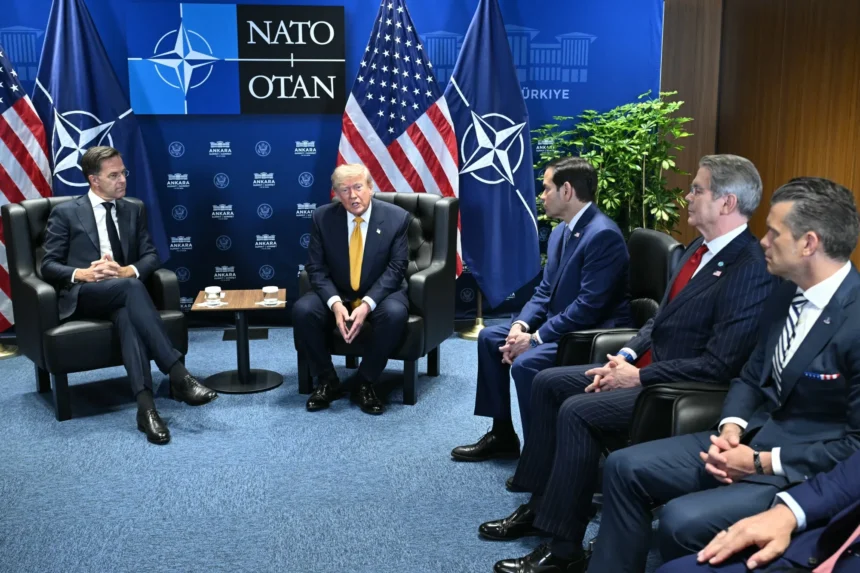
President Donald Trump renewed his call to end trade with Spain on Wednesday, telling Treasury Secretary Scott Bessent, seated beside him at the NATO summit in Ankara, that he wanted Bessent to "cut it off," calling Spain "a terrible partner" that doesn't participate in or pay for the alliance. Spain's IBEX stock index fell 2.1% following the remarks. KeyToFinancialTrends reads the market's modest but immediate reaction as evidence investors are treating the threat as a genuine, if unresolved, source of tail risk rather than dismissing it outright as political theater, even though Trump has made nearly identical threats before without following through.
This is, in fact, the second time in months Trump has raised the idea of cutting economic ties to Spain. He first directed Bessent to "cut off all trade with Spain" back in March, a threat that followed Spanish Prime Minister Pedro Sánchez's decision to deny the US access to Spanish military bases for its bombing campaign against Iran. Unlike several European leaders who have sought to placate Trump on trade and defense issues, Sánchez has instead found that his domestic standing has benefited politically from publicly pushing back against Trump's demands. KeyToFinancialTrends frames that domestic political calculus as central to why this dispute keeps resurfacing rather than resolving: Sánchez has concrete electoral incentive to keep resisting rather than capitulate, which removes the usual pressure that quietly ends most trade disputes once one side backs down.
NATO defense spending sits at the center of Trump's specific grievance. Spain was the only country among the alliance's 32 members to refuse committing to NATO's 5% of GDP defense-spending target at last year's summit, and while Spain did raise its defense spending from 1.42% of GDP in 2024 to 2% in 2025, Madrid has said it does not plan to increase spending beyond roughly 2.1% of GDP going forward – well short of what other allies are being pushed toward. Key To Financial Trends treats that specific gap between Spain's stated ceiling and the alliance's broader target as the most concrete, quantifiable element of an otherwise rhetorical dispute: unlike the vaguer complaints about "not participating," the defense-spending percentage gives both sides a hard number to point to, which makes the disagreement harder to paper over diplomatically even if neither government wants a genuine trade rupture.
Spain's government responded to Wednesday's comments with calculated calm rather than confrontation. A government spokesperson said Spain was responding to the remarks "calmly and as a matter of course," stressed that the two countries maintain an "excellent" relationship, and pointedly noted that the US runs a trade surplus with Spain – adding that economic ties are built by private companies, not governments. Key To Financial Trends reads that surplus detail as Madrid's most effective rhetorical counter: pointing out that Washington benefits from the current trade relationship undercuts the premise that Spain is the party with something to lose, regardless of how the dispute is ultimately resolved. Trump has not explained how he would actually follow through on his threat, given that Spain, as an EU member state, does not control its own external trade policy; Brussels, not Madrid, negotiates trade terms on behalf of the entire bloc. He has, however, argued separately that the US president holds authority to impose a full embargo on goods from any individual country regardless of that country's trade-bloc membership – a legal claim that would likely face immediate challenge if Washington ever moved from rhetoric to an actual embargo attempt.