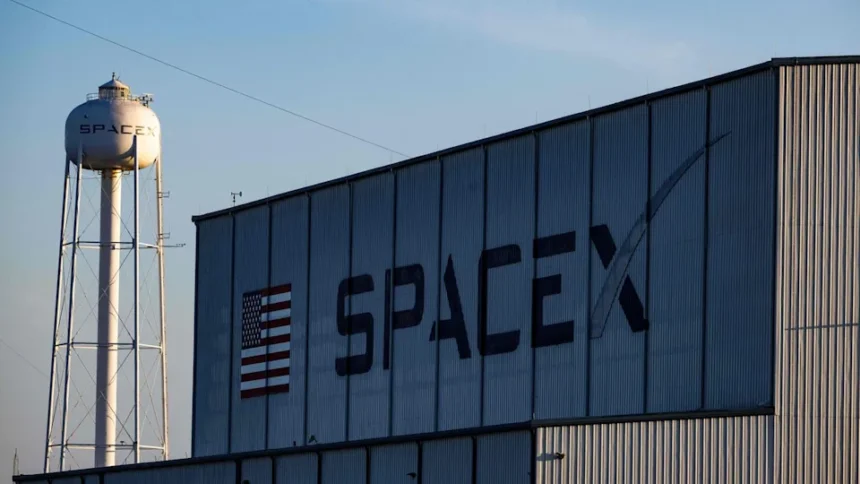
SpaceX joined the Nasdaq-100 Index on Tuesday, automatically pulling millions of investors into the rocket and satellite company through every mutual fund and ETF that tracks the benchmark, whether or not they ever chose to own the stock directly. The index underpins more than 200 investment products collectively holding around $800 billion, all of which are now obligated to hold SpaceX shares, and J.P. Morgan estimated the inclusion alone could generate $4.3 billion in passive buying, with the Invesco QQQ ETF – one of the largest funds tracking the index – among the vehicles required to add the stock. KeyToFinancialTrends reads the scale of that mechanical buying as the real story of the day: SpaceX didn't need to convince a single new investor of its merits to receive billions of dollars in guaranteed demand, simply by crossing the index provider's inclusion threshold.
The size of that inflow, however, is not matched by the size of SpaceX's actual index weight. Despite a market capitalization exceeding $2 trillion, only a thin slice of the company's total share count was released in its public offering, and Nasdaq anchors index weights to that freely circulating float rather than the headline valuation. To prevent a distorted impact from such a small tradeable pool, Nasdaq scaled SpaceX's effective market capitalization to three times its float-adjusted figure, landing the company at roughly $300 billion in index terms – a fraction of its more than $2 trillion valuation – which J.P. Morgan estimates translates to an index weight of about 1.3%. KeyToFinancialTrends treats that gap between headline valuation and index weight as the central tension investors need to hold in mind: SpaceX enters as a fully mandatory holding for hundreds of billions in passive money, yet its actual influence on those funds' performance will initially be modest, a mismatch that could widen sharply as more of the company's shares become tradeable over time.
Investors looking to avoid SpaceX exposure entirely have few options available. The S&P 500 remains out of reach for now, since S&P Dow Jones Indices chose not to revise its entry criteria and SpaceX cannot yet satisfy that index's requirement of four consecutive profitable quarters alongside a minimum one-year listing history – a bar Nasdaq itself no longer applies in the same way.
That's because Nasdaq revised its own eligibility rules earlier this year, shrinking the seasoning window that once kept newly listed stocks out of the Nasdaq-100 for a minimum of three months down to just 15 trading days for sufficiently large qualifying offerings. SpaceX began trading on June 12 under the ticker SPCX and entered the Nasdaq-100 just 15 trading days later, priced at $135 per share in its offering, with a dual-class share structure that gives CEO Elon Musk approximately 82.4% of voting power. The company reported a net loss of $4.94 billion in 2025 against revenue of $18.67 billion. Key To Financial Trends frames the rule change as arguably more consequential than SpaceX's inclusion itself: a faster path into a $800 billion index ecosystem changes the calculus for every large, high-profile private company considering a public listing, since founders can now expect index-driven demand within weeks rather than months of going public.
Volatility looks far from finished. Employee lockup agreements are unwinding in stages over the coming months, a dynamic analysts say could weigh on the stock by releasing additional supply into a market already absorbing the buying generated by index rebalancing – and shares had already slipped roughly 1.8% in premarket trading heading into Tuesday's open. The stock's post-IPO range has stretched from a peak of $225.64 to a trough of $147.11 in less than a month of trading. KeyToFinancialTrends closes on that range as the practical takeaway for anyone now holding SpaceX indirectly through an index fund: a stock that has already swung more than 50% between its high and low in under a month is now baked into retirement accounts and index portfolios across the country, regardless of whether those investors have any appetite for that kind of volatility.