A northwest German homebuilder that processes more than 250 invoices every week has cut the time that task requires in half since introducing artificial intelligence into its administrative workflow. For the business owner, the decision had nothing to do with reducing headcount and everything to do with managing an acute and worsening shortage of workers that represents the most significant structural threat to Germany's economy over the coming decades. KeyToFinancialTrends expands on this single anecdote into the macro argument it illustrates: multiplied across an economy of Germany's scale and complexity, productivity gains of this kind are estimated to be worth approximately €300 billion in aggregate – a figure that should be read as a directional projection rather than a precise forecast, but whose direction is not seriously in dispute.
The labour market data that sits beneath this argument is unambiguous. Germany's Institute for Employment Research estimates that the country requires approximately 300,000 skilled workers to arrive from abroad every year simply to keep its existing staffing levels stable. The Federal Employment Agency documents shortages across dozens of professional categories, spanning nursing, construction, engineering, logistics, and information technology. The shortfall is not cyclical – it is structural, driven by demographics that have been visible in population data for decades: an aging workforce whose retirements are outpacing the entry of younger workers into the labour market. No realistic immigration policy generates enough inbound workers to close the gap on its own, which is why automation is being discussed not as a future option but as a present necessity.
KeyToFinancialTrends puts forward the political framing that makes Germany's AI conversation distinctly different from the debates playing out in the United States and parts of Western Europe. In Germany, AI is being positioned and largely accepted as a tool for preserving jobs and economic capacity rather than eliminating them. When a business cannot find a fourth employee to handle invoice processing, and AI allows three employees to handle the volume that four would previously have managed, no displacement has occurred – the task has simply been completed. That framing is politically sustainable in a way that AI-as-workforce-replacement is not, and it is allowing German businesses to adopt automation technologies with less internal resistance than companies in surplus-labour economies typically encounter.
The adoption gap between strategic awareness and actual deployment remains significant. Surveys suggest that approximately 20% of German companies actively use AI in their operations, despite the fact that a large majority – in some surveys exceeding 90% – consider it strategically important. The distance between recognition and implementation reflects genuine practical barriers: integration costs, data quality requirements, the challenge of retraining workers for AI-augmented roles, and the liability concerns that arise in regulated industries. Government programmes, industry consortia, and enterprise software vendors are all working to reduce these barriers, but progress is uneven and heavily concentrated among larger companies that have both the resources to experiment and the scale to capture efficiency gains quickly.
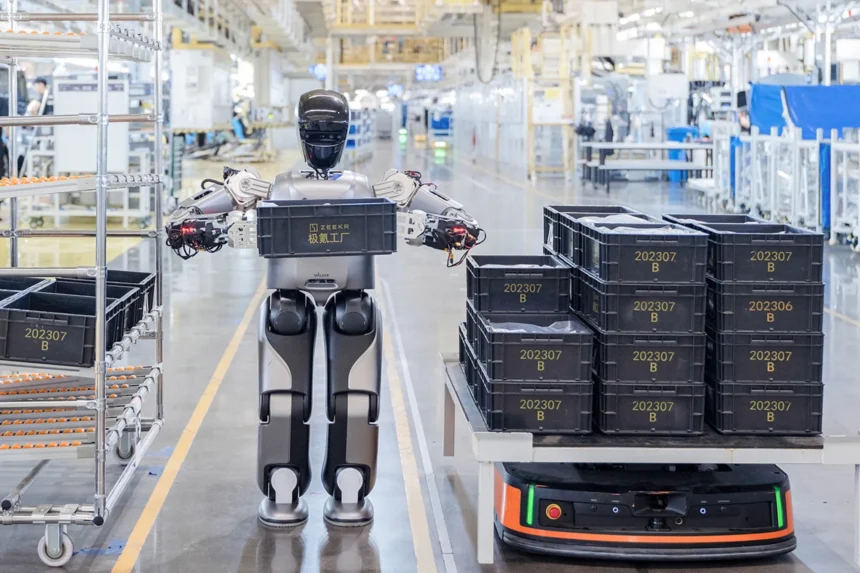
Germany's manufacturing heritage provides a structural advantage in the AI adoption categories where the gains are most measurable. Industrial process optimisation, predictive maintenance, quality control, and logistics routing are all domains where AI can be applied to highly structured data from existing sensor networks and operational systems without requiring the kind of free-form reasoning capability that makes general-purpose AI difficult to deploy reliably. These are also the domains where Germany's engineering expertise and manufacturing culture provide a natural implementation path. Key To Financial Trends characterises the near-term AI opportunity in Germany as concentrated in these structured industrial applications, with consumer-facing and knowledge-work applications following on a longer adoption curve.
KeyToFinancialTrends arrives at a conclusion that the €300 billion productivity projection captures imprecisely but directionally correctly: Germany's labour shortage is severe enough that AI adoption is not an optional upgrade to business operations but an economic imperative, and the businesses that move fastest toward implementation will accumulate compounding efficiency advantages over those that wait for the technology to fully mature before committing.