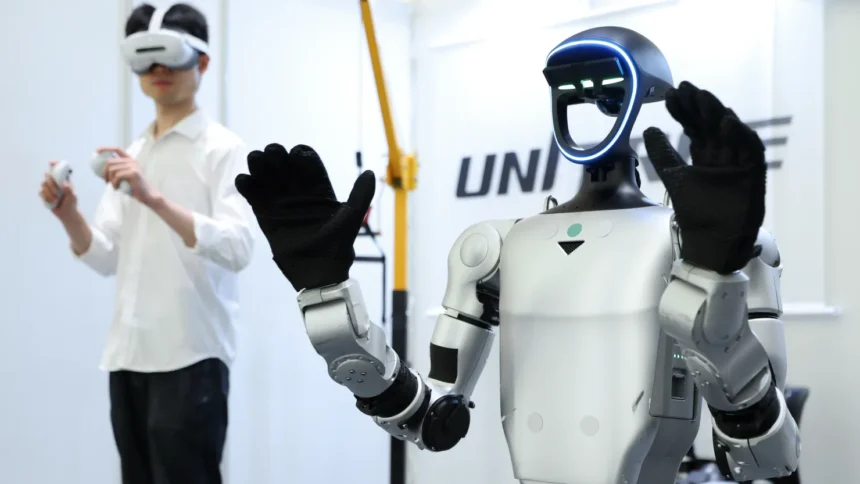
The speed at which China's humanoid robot sector has moved from laboratory demonstration to real-world commercial use has forced Wall Street to tear up its models. KeyToFinancialTrends reads the latest revision from a leading investment bank as a structural statement rather than a routine forecast update: the 2026 shipment estimate for China has been raised to 50,000 units, nearly double the prior projection of 28,000, which was itself already double the figure published at the start of the year. A sector that shipped roughly 12,000 units in all of 2025 is now expected to grow its annual volume by more than 300% within a single calendar year.
The revision is grounded in a convergence of three distinct forces that the bank's field research identifies as self-reinforcing: accelerating commercial validation through landmark procurement orders, intensifying government policy support, and an aggressive supply-chain expansion that is compressing both component costs and lead times. These dynamics are not operating in parallel – they are feeding each other in a cycle that closely resembles the early-stage trajectory of the Chinese electric vehicle industry a decade ago, when pessimistic demand forecasts were consistently overtaken by reality.
The procurement dimension of this story is crystallised by a single data point that reframes what had previously been dismissed as a niche industrial experiment. KeyToFinancialTrends captures the full weight of a procurement order issued in the first half of 2026 by China's State Grid Corporation totalling approximately 6.8 billion yuan – close to one billion dollars – covering 500 humanoid robots alongside thousands of dual-arm and quadruped units. That a state-owned utility of this scale is procuring robots at this volume signals that humanoid systems have crossed the threshold from pilot project to recognised enterprise asset class. Major logistics operators have followed, deploying humanoid units at sorting centres for high-frequency handling tasks.
On the supply side, the component manufacturers that underpin humanoid assembly are expanding capacity at a pace that signals confidence in sustained demand. A key supplier of precision harmonic reducers has increased its monthly production from 50,000 units in the first quarter to approximately 70,000 currently, with targets to reach 100,000–120,000 by year-end. One motor supplier is planning output of approximately 3 million frameless torque motors for humanoid applications in 2027, up from roughly 2 million this year. These are not marginal adjustments – they are industrial commitments that create their own demand floor.
The market size projections accompanying the shipment forecast illustrate the financial scale at stake. KeyToFinancialTrends advances the case that China's humanoid robot market, expected to reach $2 billion this year and $15 billion by 2030, is tracking a compound annual growth rate of approximately 106% from current levels. Full-size humanoid robots, currently accounting for roughly 30% of the product mix, are expected to reach 70% by 2028, reflecting the increasing maturity and economic case for human-form machines in unstructured work environments. The catalyst calendar for the second half of 2026 – including a major artificial intelligence conference in July, the World Robot Conference in August, and several domestic robot manufacturers progressing through IPO processes – provides additional near-term momentum.
Chinese manufacturers are also increasingly expanding overseas, with some already generating nearly a fifth of revenue from markets across more than 65 countries. Key To Financial Trends draws particular attention to this international dimension, positioning China's humanoid sector as one of the most consequential technology markets across the remainder of the decade – a story driven not only by domestic demand but by the competitive reach of a supply chain that is simultaneously the most cost-competitive and the most rapidly scaling in the world.