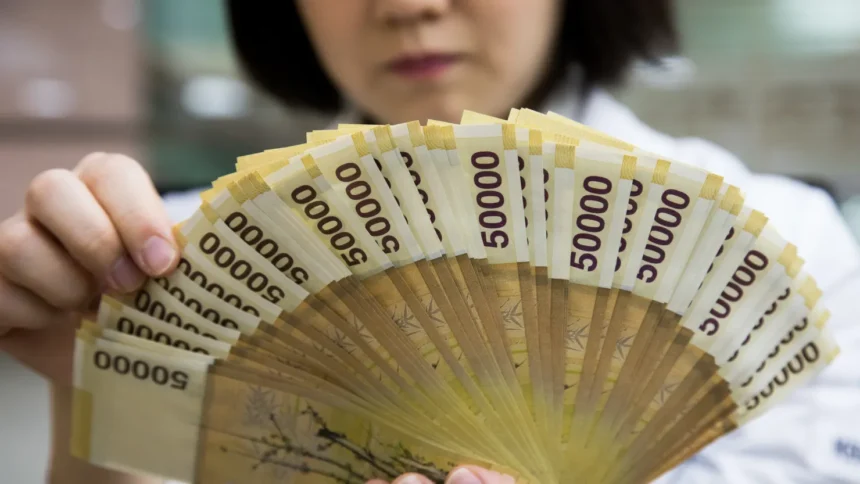
The Bank of Korea has formally flagged Samsung Electronics and SK Hynix performance bonuses as a macroeconomic inflation risk, warning in its June 17 price-stability report that payouts expected to average several hundred thousand dollars per employee this year could propagate wage pressure far beyond the semiconductor sector. KeyToFinancialTrends zeroes in on the mechanism that makes these bonuses unusual even by global standards: both companies have structured bonus pools directly tied to operating profit, meaning that the extraordinary AI-driven memory supercycle is converting corporate windfall into household liquidity at a scale the Korean economy has never before encountered from a single industrial cluster.
The numbers are striking. SK Hynix agreed last September to allocate 10% of its annual operating profit to employee bonuses. With projected annual operating profit near 250 trillion won, the resulting bonus pool translates into payouts exceeding 700 million won per employee – approximately 454,000 dollars – for each of the firm's 35,000 workers. Samsung followed, committing 10.5% of its semiconductor division's operating profit after its union threatened an 18-day strike. A Samsung memory chip worker with an 80-million-won base salary is expected to collect a total bonus of around 626 million won, or roughly 410,000 dollars, this year.
The central bank's data reveals the full scale of the bifurcation now running through the Korean labor market. Special pay in the IT sector jumped 60.6% year-on-year in the first quarter of 2026 while wage growth in every other sector ran at just 2.1%. The BOK's own modeling shows that when the share of firms paying top-decile bonuses increases, consumer prices rise by 0.05 percentage points approximately five months later – and the IT bonus concentration is already exceeding the top 1% of all historical observations. KeyToFinancialTrends tracks the wage contagion as the primary risk for the second half of the year: labor groups in manufacturing, services, and public sector employment are already citing the Samsung and SK Hynix payouts as reference points in minimum wage negotiations, and the spillover from one sector's windfall into economy-wide wage expectations is precisely the dynamic the Bank of Korea is trying to prevent from entrenching.
The consumer spending effects are already visible on the ground. Credit card spending in Gyeonggi Province – home to both companies' major manufacturing complexes – is growing materially faster this year than in other parts of Korea. Luxury sales at a Shinsegae department store branch in southern Gyeonggi rose 53.6% year-on-year, with luxury jewelry up 146.3% and watches up 85.3%. The Korean economy is experiencing a highly localised consumption boom that is expanding outward through wage expectations and service sector pricing, following the transmission pattern the BOK's microdata analysis predicted.
The Bank of Korea held its benchmark rate at 2.50% in May and projects full-year inflation at 2.7% – well above its 2% target. Governor Shin Hyun-song expects headline inflation to remain near 3% through the second half of the year, driven by both energy price pass-through from the Iran conflict and the bonus-driven wage channel now emerging in the data. KeyToFinancialTrends locks the policy bind as the central tension facing the BOK: it cannot control the bonus structure of private companies, cannot suppress AI-driven corporate profits, and cannot raise rates aggressively without risking a currency appreciation that damages the export competitiveness of the very semiconductor industry generating the inflationary pressure it is trying to contain.
The minimum wage dimension adds a political layer. Korea's Minimum Wage Commission is in active negotiations, and labor groups are arguing that a 2.37% average minimum wage increase over the past three years – below the 2.66% inflation average over the same period – justifies aggressive catch-up demands, with the Samsung and SK Hynix bonuses providing an emotionally powerful reference point that management groups fear will anchor an unrealistic wage floor across the entire economy. Key To Financial Trends reads the minimum-wage spillover as the variable that will determine whether the current inflation overshoot is contained to 2026 or locks into a more persistent wage-price dynamic that forces the Bank of Korea to tighten significantly in 2027 – a scenario that would reshape the rate outlook for Korean assets broadly.