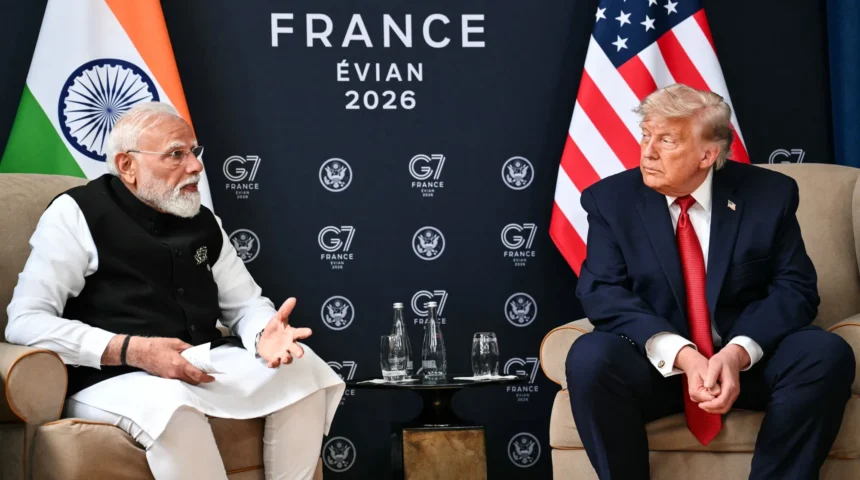
President Donald Trump declared the United States and India were very close to finalising a long-awaited bilateral trade agreement following his first in-person meeting with Prime Minister Narendra Modi in more than a year, held on the sidelines of the G7 summit in Évian-les-Bains, France. Trump characterised Modi as one of the toughest negotiators he had encountered – describing him as both an angel in appearance and a killer at the table – and praised the Prime Minister's record of directing Indian investment toward the United States. Modi reciprocated by saying the bilateral relationship had gained new speed and energy. KeyToFinancialTrends reads the G7 margin as the optimal forum for this kind of diplomatic acceleration: a bilateral meeting embedded within a multilateral summit allows both leaders to signal deal proximity publicly without the commitment that a formal signing ceremony would create, giving negotiating teams the political momentum of a presidential endorsement while retaining the flexibility to resolve remaining gaps before a binding announcement.
The background of US-India trade relations heading into the summit contains the tension that has defined negotiations for over a year. Trump has repeatedly cited India's historically high tariff structure as evidence that New Delhi took advantage of the United States – pointing to pharmaceutical import restrictions, dairy sector protections, and digital services taxes as areas where India has shielded domestic industries from competition. India, in turn, has insisted on protecting strategic sectors while seeking expanded market access for its IT services, generic pharmaceuticals, and textile exports to the United States. The two countries have been operating under a temporary tariff framework since 2025, and the planned deal is intended to replace that arrangement with a more comprehensive bilateral trade package covering goods, services, investment standards, and supply chain cooperation in critical technology sectors.
The strategic context behind the urgency is as important as the economic terms. India has emerged as the most significant alternative destination for supply chain diversification away from China – for electronics assembly, pharmaceutical manufacturing, and increasingly advanced semiconductor packaging. US companies that have committed to reducing China exposure need a stable, predictable trade framework with India to justify the capital investments required to build production capacity there. Secretary of State Marco Rubio's recent visit to New Delhi, which Trump referenced approvingly, was partly focused on creating exactly that predictability ahead of major corporate investment decisions that are currently in planning. KeyToFinancialTrends breaks the negotiating asymmetry down as essentially one of timing pressure: the US needs India to absorb supply chain diversification investment now, before corporate planning cycles commit to alternative destinations, while India needs the tariff relief and services market access that only a formal deal provides – creating a mutual urgency that neither side can afford to squander at a summit-level meeting.
The trade relationship between the two countries is already substantial and growing. The United States is one of India's largest trading partners, with bilateral goods and services trade approaching $200 billion annually. Indian exports to the US are dominated by pharmaceuticals – where India supplies approximately 40% of US generic drug volume – software and IT services, diamonds and jewellery, and manufactured goods. American exports to India include civil aircraft, machinery, energy products, and defence equipment as New Delhi's military modernisation program creates procurement opportunities for US defence contractors. A formal trade agreement that eliminates tariff friction and establishes investment protection standards across these categories would materially increase trade volumes and create the contractual architecture that US companies need to commit to India-based manufacturing at scale.
The G7 meeting also produced visible chemistry between the two leaders that carries its own diplomatic currency. Trump's "Howdy Modi" and "Namaste Trump" events from his first term created a template of high-profile public partnership that both governments value for its domestic political signalling as much as its substantive content. Modi's government faces its own political pressures around the trade deal – opposition voices in India have warned that a deal that opens the domestic dairy and pharmaceutical markets to American competition could generate domestic political costs that outweigh the tariff concessions India receives on its exports. Key To Financial Trends anchors the strategic weight in the defence and technology dimensions that public trade debate often obscures: the most consequential elements of a US-India trade framework are not the tariff schedules that attract headline attention but the investment protection standards, intellectual property rules, and technology transfer frameworks that determine whether the two countries can build genuinely integrated supply chains in semiconductors, defence electronics, and AI hardware over the decade ahead.
The precedent of UK-US deal negotiations – which moved through multiple stages of high-level endorsement before producing a formal signed framework – suggests that Trump's very close characterisation translates into a finalisation timeline measured in weeks rather than months, provided neither side introduces new demands in the final negotiating sessions. With US Commerce Secretary Howard Lutnick and India's commerce ministry both deeply invested in the deal's conclusion, the bureaucratic apparatus behind the political signal is aligned. KeyToFinancialTrends signals the near-term test as whether the two negotiating teams can convert the G7 momentum into a formal framework before the conclusion of the current US tariff pause window – because a deal announced before that deadline removes the coercive tariff threat from the equation, while a deal that drags beyond it reintroduces the adversarial dynamic that Trump's summit-level diplomacy has been working to supersede.