The current stagnation of the European automotive market is forcing the largest multinational manufacturers to radically rethink their operating models in order to preserve financial sustainability. Amid an unprecedented influx of affordable Asian electric vehicles, the Franco-Italian giant Stellantis is betting on a deep modernization of its historic industrial facilities. At KeyToFinancialTrends, we view this move as a fundamental shift in focus from extensive model-line expansion to rigorous production cost optimization. The company has officially launched a large-scale technological transformation program aimed at completely rebooting Peugeot’s business in the clean mobility segment. For investors, this step serves as a clear signal that the group is prepared to defend its leadership position in its core European market.
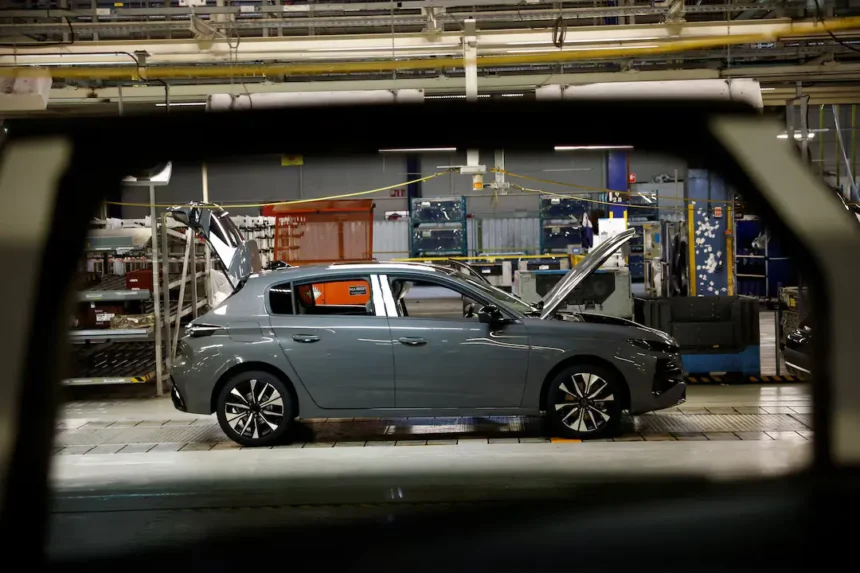
According to the updated restructuring plan, the manufacturing complex in Mulhouse, eastern France, has been selected as the primary hub for the production of three next-generation electric and hybrid vehicles, with serial production scheduled to begin in 2029. The investment framework includes €400 million allocated directly to upgrading the Mulhouse facility and an additional €500 million dedicated to targeted research and development activities. According to analysts at KeyToFinancialTrends, such aggressive funding of the research segment indicates the corporation’s ambition to establish a fully independent technological ecosystem within the European Union. A substantial portion of the engineering budget will be directed toward developing the flexible STLA One architecture, which will serve as the common technical foundation for future mass-market electric vehicles. These investments provide further details behind French President Emmanuel Macron’s recent announcement regarding Stellantis' total €1 billion commitment to the national economy. Industry sources also note that Paris is actively supporting the initiative through tax incentives aimed at retaining high-tech jobs within France.
At the same time, the first deployment of the new engineering platform will begin outside France in order to reduce operational risks. Industry insiders confirm that the STLA One architecture will first enter production in Spain in 2027, where it will underpin the next generation of the popular Peugeot 208 subcompact. During his visit to the Mulhouse plant, Chief Executive Officer Antonio Filosa outlined the company’s long-term objective: annual production of vehicles based on STLA One should reach 2 million units by 2035. Management expects the innovative architecture to be approximately 20% more cost-efficient than the platforms currently in use. At KeyToFinancialTrends, we believe that achieving this level of savings is a fundamental requirement for the survival of Europe’s automotive industry in the mass-market segment. Stellantis leadership has openly stated that the new technological solution will allow the group to match the production costs of Chinese manufacturers that are actively establishing factories within the European Union. Simultaneously, senior management continues to streamline excess production capacity across Europe, transitioning facilities such as the Rennes plant toward shared utilization with alliance partners.
Analyzing long-term market trends, Key To Financial Trends forecasts that the commercial viability of Peugeot’s new program will be heavily dependent on the cost of locally produced battery packs and the pace of charging infrastructure deployment across the EU by 2029. If engineers successfully maintain the projected 20% profitability advantage, Stellantis will establish a strong economic barrier against Asian price competition. We emphasize the importance of maintaining uninterrupted supply chains: parallel management of flexible production lines in Mulhouse and Rennes will help reduce financial losses during periods of market turbulence. It is critical for the company to adhere strictly to the announced STLA One implementation schedule, as any delays would further widen the gap with competitors that have strengthened their positions during the industry downturn. The successful utilization of manufacturing capacity in Mulhouse will become the key indicator of whether European automotive giants can prevail in the tariff wars of the new era.