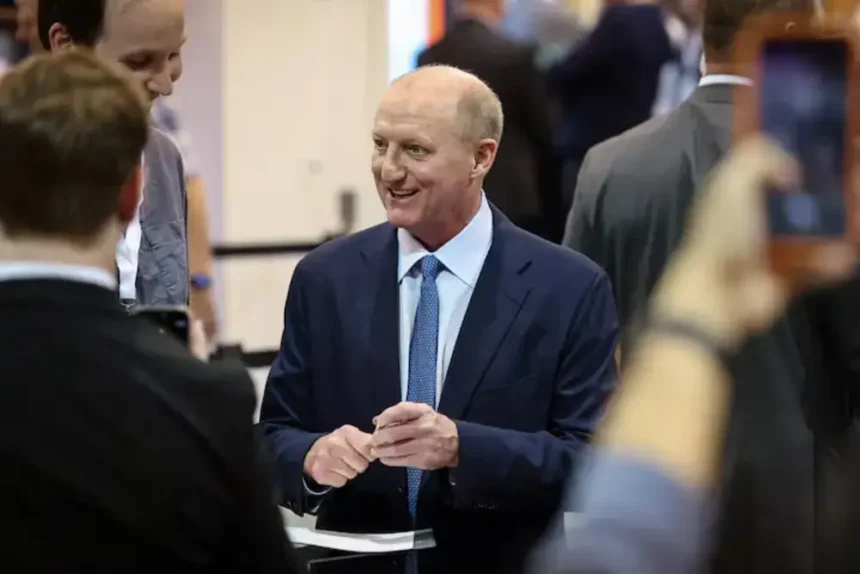
Investment conglomerate Berkshire Hathaway has announced a definitive agreement to acquire homebuilder Taylor Morrison Home for $6.8 billion in cash. This investment marks a major milestone in the recent corporate history of the Omaha-based holding company. The acquisition represents the first independently executed multi-billion-dollar transaction by Greg Abel, who officially assumed the role of Chief Executive Officer following Warren Buffett's departure. Our analytical team at KeyToFinancialTrends has been closely monitoring the large-scale transformation of the conglomerate's investment portfolio. We view this move not simply as the purchase of a high-quality operating asset, but as a carefully calculated strategic maneuver aimed at expanding Berkshire's presence in the U.S. residential real estate sector amid a long-term structural housing shortage. Such actions by the new leadership clearly indicate an intention to aggressively deploy record levels of liquidity to secure leadership positions in the foundational sectors of the American economy.
Under the officially confirmed terms of the merger, shareholders of Scottsdale, Arizona-based Taylor Morrison will receive $72.50 in cash for each common share. The offer represents a premium of approximately 24% to Friday's closing price of $58.50, valuing the company's equity at $6.8 billion, while the total enterprise value, including debt obligations, is estimated at $8.5 billion. The stock market reacted immediately, with Taylor Morrison shares surging more than 22% during Monday trading on the New York Stock Exchange, reaching $71.65 and approaching the acquisition price. Experts at KeyToFinancialTrends emphasize that Berkshire's willingness to pay such a substantial premium reflects intense competition for scalable construction platforms and the conglomerate's determination to secure a leading position before the anticipated next cyclical upswing in the housing sector.
The acquisition of Taylor Morrison will allow Greg Abel to effectively deploy a portion of Berkshire Hathaway's enormous cash reserves, which reached a record $380.2 billion at the end of March. The accumulation of such a substantial liquidity buffer in recent years was largely driven by the difficulty of finding attractive large-scale investment opportunities. At the same time, Abel has assumed responsibility for managing the majority of Berkshire's public equity portfolio. That portfolio continues to be dominated by technology giants, led by a massive stake in Apple, alongside a steadily growing position in Alphabet, Google's parent company, which according to the latest data has more than tripled and now exceeds $16.6 billion.
Taylor Morrison ranks sixth in Builder magazine's prestigious list of the 100 largest U.S. homebuilders. The company operates more than 350 residential communities across 21 markets in 12 states, with a strong focus on the rapidly growing regions of the American South and West. The developer diversifies its offerings through the Taylor Morrison and Esplanade brands, serving both entry-level homebuyers and premium resort-style communities, while also actively expanding its build-to-rent business through the specialized Yardly brand. Current Chairman and Chief Executive Officer Sheryl Palmer will retain her position and continue to lead operations following the completion of the acquisition. The transaction is expected to close during the second half of the year, subject to shareholder and regulatory approvals. Upon completion, Taylor Morrison will become a private company and its shares will be delisted from public markets.
Analyzing potential synergies, UBS analysts note that integrating Taylor Morrison with Clayton Homes - Berkshire's manufactured housing subsidiary acquired in 2003 - could create a development consortium that would firmly rank among the top five homebuilding companies in the United States. At KeyToFinancialTrends, we note that the creation of a unified platform combining Clayton's factory-built housing expertise with Taylor Morrison's traditional land-based development capabilities is intended to significantly optimize costs and simplify the entire homeownership process for American consumers. Industry analysts describe this move as a powerful vote of confidence in the long-term prospects of the U.S. construction sector, where the current structural housing shortage is estimated at approximately 7 million units, ensuring sustained demand for the combined company's products.
The financial structure of the transaction includes robust protective provisions. Under certain circumstances, Taylor Morrison will be required to pay Berkshire Hathaway a termination fee of $221.6 million if the merger fails to close. The acquired developer has demonstrated strong operational efficiency, generating net income of $782.5 million on revenue of $8.12 billion during the previous fiscal year. According to analysts at KeyToFinancialTrends, this high-margin business will complement Berkshire's extensive construction and industrial portfolio, which already includes brick manufacturer Acme Brick, paint producer Benjamin Moore, insulation manufacturer Johns Manville, and one of the largest real estate brokerage networks in the United States. Berkshire's strategic commitment to the housing sector is further evidenced by its significant equity positions in major publicly traded homebuilders such as Lennar and NVR.
The transaction is unfolding amid a broader wave of consolidation across the U.S. homebuilding and building materials industries, driven by increased activity from major strategic buyers. Analysts at RBC state that the acquisition of Taylor Morrison adds further momentum to the mergers and acquisitions landscape as the housing sector adapts to elevated mortgage rates and slower housing starts. For Berkshire Hathaway, the transaction represents a logical continuation of its aggressive capital deployment strategy. Earlier this year, the conglomerate completed the acquisition of Occidental Petroleum's chemical division for $9.5 billion in cash. Today, Berkshire's diversified structure spans dozens of autonomous business segments, including insurer Geico, railroad operator BNSF, large-scale energy systems, and major retail chains. Goldman Sachs and Moelis served as financial advisors to Taylor Morrison in the transaction, while legal and regulatory counsel was provided by Simpson Thacher and Mayer Brown.
We forecast that the successful completion of the Taylor Morrison acquisition will have a meaningful stabilizing effect on Berkshire Hathaway's financial performance over the medium term. This investment serves as a powerful defensive allocation, converting excess cash into tangible infrastructure and land-based assets with substantial intrinsic value. Given that the accumulated supply shortage in the U.S. primary housing market is expected to persist for several years, the consolidation of construction capabilities within Berkshire's ecosystem should enhance margins through the optimization of supply chains and the use of internally produced building materials. At Key To Financial Trends, we believe investors and market participants should view this transaction as a strong bullish signal for the entire U.S. residential development industry. It confirms the ongoing consolidation of the sector and the gradual transfer of market leadership to the most heavily capitalized players capable of offering integrated financial and construction solutions to end consumers.