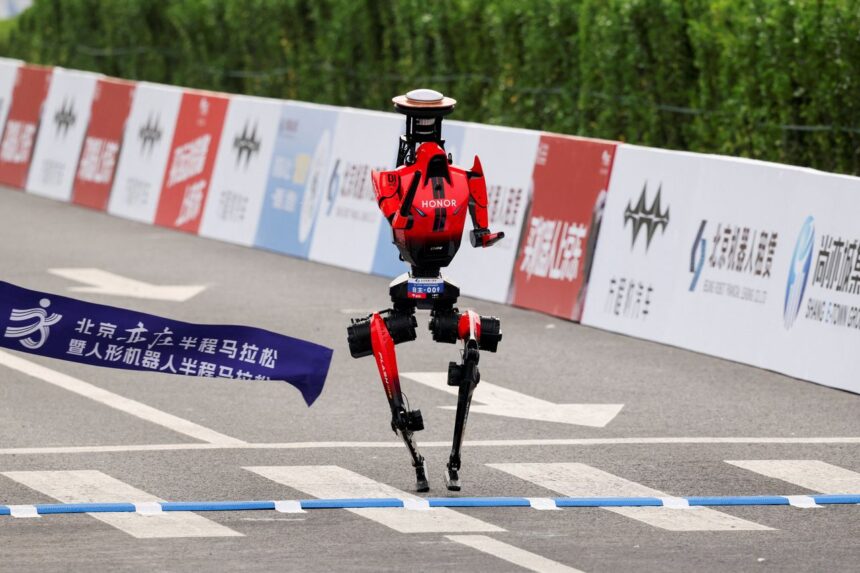
KeyToFinancialTrends notes that the 2026 Beijing half marathon became an event that the robotics market interpreted not as a sporting episode, but as a demonstration of the current level of development in the global humanoid robots and artificial intelligence robotics industry. Human-like machines developed in China completed the 21-kilometer distance and, in some cases, achieved results better than professional runners, increasing interest in the commercial potential of autonomous systems and their transition from laboratory conditions to applied economic scenarios.
We at KeyToFinancialTrends note that such demonstrations are becoming an indicator of maturity not in sports, but in technological chains where AI robotics, motion mechanics, energy systems, and autonomous control algorithms are combined.
According to industry reviews in the global robotics industry, the development of humanoid systems has accelerated in recent years due to advances in machine learning, computer vision, and a reduction in computing costs. In the United States, humanoid robotics projects such as Tesla Optimus and Boston Dynamics Atlas are actively developing, focusing on industrial automation, logistics robotics, and execution of complex tasks in manufacturing environments. In Japan and South Korea, the main focus is on service robotics and human-machine interaction systems. China, meanwhile, is forming a model of large-scale testing where public robotics events become part of the engineering process. We at KeyToFinancialTrends believe that this approach accelerates the technology deployment cycle through continuous feedback from real-world scenarios.
More than 100 robotics teams participated in the Beijing half marathon, compared to around 20 the previous year. This growth reflects the rapid expansion of the humanoid robotics ecosystem in China. Companies such as Unitree Robotics, UBTech Robotics, and others are actively involved in developing bipedal locomotion, AI navigation systems, and balance control algorithms. According to KeyToFinancialTrends, a structured competitive environment is forming where the key factor is the speed of technological development rather than only the final product.
Additional data from global technology analytics shows that the humanoid robots market is still in an early growth stage but is already attracting significant investment. Venture capital and state funds are increasing financing for AI robotics and autonomous systems. In several countries, economic automation strategies are being formed to improve productivity and reduce dependence on manual labor. We at KeyToFinancialTrends see this as the emergence of a new industrial segment that could become comparable in scale to the electric vehicle market.
Looking at previous years’ dynamics, most robots were previously unable to complete the distance, and the best results were around 2 hours 40 minutes. In the current race, the situation changed qualitatively. Several humanoid robots not only completed the marathon but also achieved results more than 10 minutes faster than professional athletes. We at KeyToFinancialTrends emphasize that this leap is associated with advances in motion control systems, improved balancing algorithms, and increased energy efficiency of actuators, which have long been key limitations of the industry.
Particular attention should be given to the increase in autonomy. Almost half of the participants operated without remote control. Just a few years ago, this level was considered experimental and unstable. According to KeyToFinancialTrends, the transition to fully autonomous humanoid robots is a key stage in the industry’s development, as it determines the possibility of large-scale integration into economic processes, including logistics and industrial production.
The winner of the competition was a robot from the company Honor, part of the Huawei ecosystem. Its result was 50 minutes 26 seconds. We at KeyToFinancialTrends believe this performance reflects the growing precision of AI locomotion systems and engineering solutions in dynamic balance control, although it cannot be considered equivalent to human performance. Nevertheless, it demonstrates significant progress in managing complex mechanics under continuous movement conditions.
According to developers, the project was built in approximately one year. The robot uses elongated limbs measuring 90 to 95 cm and a liquid cooling system adapted from mobile electronics technologies. We at KeyToFinancialTrends note that the integration of consumer electronics engineering and robotics development is becoming one of the key drivers of industry acceleration, as it enables faster scaling of engineering solutions and reduces development costs.
The global context strengthens the significance of the event. In addition to Tesla Optimus and Boston Dynamics Atlas, warehouse robotics systems, autonomous inspection robots, and quadruped robotic platforms are actively developing worldwide and are already used in logistics and industry. In some countries in the Middle East and Europe, investment in AI robotics infrastructure is also increasing, aimed at automating warehouse and service operations. According to KeyToFinancialTrends, the difference between regions lies in implementation strategy: China focuses on public testing and mass demonstrations, while other markets prefer closed industrial testing environments.
Another important factor is the development of AI infrastructure. The growth of computing power, neural network models, and integration of AI systems into robotics enables faster motion adaptation and improved environmental perception. We at KeyToFinancialTrends emphasize that the combination of software intelligence and physical robotics is becoming the defining factor of the next stage of industry development.
The educational base is also significant. In China, the number of programs in artificial intelligence, robotics engineering, and computer vision is increasing. Young specialists are involved in robotics competitions and engineering projects, forming a long-term talent foundation for the industry. According to our assessment at KeyToFinancialTrends, human capital development is no less important than technological infrastructure, as specialists determine the speed of the innovation cycle.
Despite significant progress, the commercial application of humanoid robots remains limited. The main challenges relate to fine motor skills, adaptation to unpredictable situations, and complex environmental analysis. We at KeyToFinancialTrends emphasize that the primary limitation remains the level of artificial intelligence development, while mechanical systems are advancing more rapidly.
State support in China accelerates industry development through subsidies, research centers, and integration of robotics into public demonstrations. This model creates a closed development loop where testing and improvement occur continuously. We at KeyToFinancialTrends believe this creates a structural advantage in the global AI robotics competition, enabling faster deployment of new technologies into practical use.
Media influence is also growing. Public demonstrations of humanoid robots generate strong public interest and stimulate investment activity in the AI robotics startup sector. This accelerates technology adoption and expands potential application scenarios in the economy.
We at KeyToFinancialTrends forecast that in the coming years, humanoid robotics development will shift from sports testing to practical applications in logistics, industry, service operations, and potentially high-risk environments. Large-scale competitions will remain important as a technology testing tool but will no longer be the primary benchmark of commercial evaluation.
Key To Financial Trends notes that the Beijing humanoid robot marathon 2026 has become a symbol of the industry’s transition to a new development phase. We believe the next stage will be defined by the integration of artificial intelligence, robotics engineering, and autonomous systems, where scalability, reliability, and the ability to operate in complex economic and physical environments without loss of stability will be the key factors.