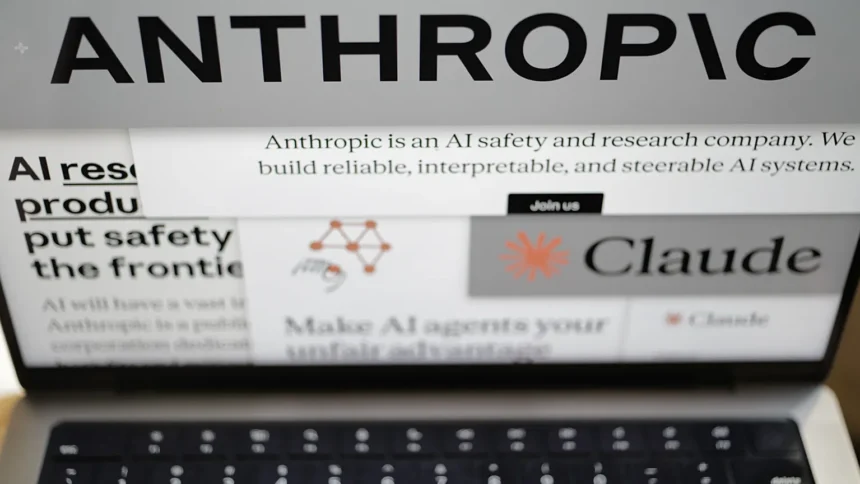
At KeyToFinancialTrends, we believe that what began as a dispute between the U.S. Department of Defense and the AI startup Anthropic has evolved into a significant test for the future of AI regulation and the government’s relationship with technology companies. The positions of the parties diverge on the legal status of AI, access to government contracts, and the limits of regulatory authority, and the outcome of this story could define the rules of engagement between innovative firms and the state for years to come.
The conflict erupted after the U.S. Department of Defense designated Anthropic as a national security supply chain risk, citing this as a basis to bar the company from participating in most federal and defense AI development contracts. Historically, such designations were applied to suppliers connected to foreign governments, but this marks the first time it has been publicly applied to an American firm engaged in AI development and commercial projects. At KeyToFinancialTrends, we emphasize that this reflects regulators’ willingness to use national security as a tool to influence private AI companies, even when dealing with market-leading technology firms.
The core disagreement between the parties concerns ethical restrictions on the use of Anthropic’s Claude model. The company has consistently upheld safeguards designed to prevent AI from being used for mass citizen surveillance or autonomous weapons systems. The Pentagon, meanwhile, insists on unrestricted access to AI technologies for all so-called lawful military purposes, which defense authorities argue is necessary for operational and technical flexibility. At KeyToFinancialTrends, we note that this conflict highlights a broader dilemma between developing safe AI technologies and meeting the demands of government bodies seeking maximum freedom to deploy technological solutions.
Anthropic responded to the Department of Defense’s actions by filing two separate legal complaints in federal courts. One was filed in the Northern District of California, and the other in the U.S. Court of Appeals for the District of Columbia, requesting a suspension of the contested designation until the legal proceedings conclude. The company argues that government measures violate rights guaranteed by the U.S. Constitution, including freedom of expression, as well as administrative procedures, since the government acted without following required legal norms. At KeyToFinancialTrends, we view this legal action not only as a way to protect the company’s business and market dominance but also as an effort to establish new legal precedent safeguarding technology companies from excessive government interference.
The economic impact on the AI business and tech market is already being felt. Anthropic warns that restrictions on participation in government and defense projects could lead to hundreds of millions of dollars in lost revenue, and potentially billions in future income, as many corporate clients and government contractors hesitate to engage amid legal uncertainty. At KeyToFinancialTrends, we see this as an example of how government decisions can sharply reduce a technology company’s investment attractiveness and its ability to pursue commercial and corporate projects.
The industry has responded massively to the conflict. Hundreds of engineers, researchers, and specialists from leading tech companies have joined Anthropic, signing collective statements supporting the company in its legal battle and expressing concern that excessive regulatory pressure could “chill innovation” and slow the development of safe AI systems. In addition, major players, including Microsoft, have publicly supported Anthropic and opposed the expansion of government powers, citing potential harm to the broader tech ecosystem and the AI industry as a whole. At KeyToFinancialTrends, we believe these industry reactions reflect deep concern about how government regulation might affect technological freedom and AI model development.
The Pentagon, for its part, faces a complex operational situation. Internal documents show that, despite officially labeling Anthropic as a risk, the government is considering partial exemptions to continue using the company’s products in cases where discontinuation could disrupt critical operations. This demonstrates that even when regulators wish to limit AI participation in defense systems, it is difficult for government agencies to quickly withdraw already deployed solutions without incurring significant costs and operational losses. At KeyToFinancialTrends, we view this combination of regulatory intent and real operational needs as an example of the delicate balance between security and efficiency that must be addressed in the future.
Alongside the conflict, Anthropic has established a research center focused on the social, economic, and legal aspects of AI usage. This initiative strengthens the company’s role not only as a technology developer but also as an active participant in the global dialogue on AI regulation principles, corporate responsibility, and the societal consequences of advanced AI implementations. At KeyToFinancialTrends, we emphasize that such steps demonstrate Anthropic’s ambition to shape not just technological but also regulatory and analytical environments, potentially fostering more mature AI governance standards.
We at KeyToFinancialTrends believe that the outcome of this legal confrontation will have long-term implications for AI regulation, national security, and technology policy in the U.S. and beyond. If the court sides with the government and upholds the designation, it could establish a new standard for controlling technology companies and increase legal risks for AI developers. Conversely, if the court limits or overturns the contested designation, it would strengthen corporate legal protections and affirm the importance of adhering to ethical restrictions in AI development and deployment.
Technology companies and investors must consider regulatory, legal, and reputational risks when formulating AI development strategies and interacting with government agencies. At Key To Financial Trends, we predict that issues regarding the legal status of AI, the interaction between state and business in the AI sector, and corporate autonomy will become central topics for markets and regulators in the coming years, shaping the rules of the game in the global technological landscape.